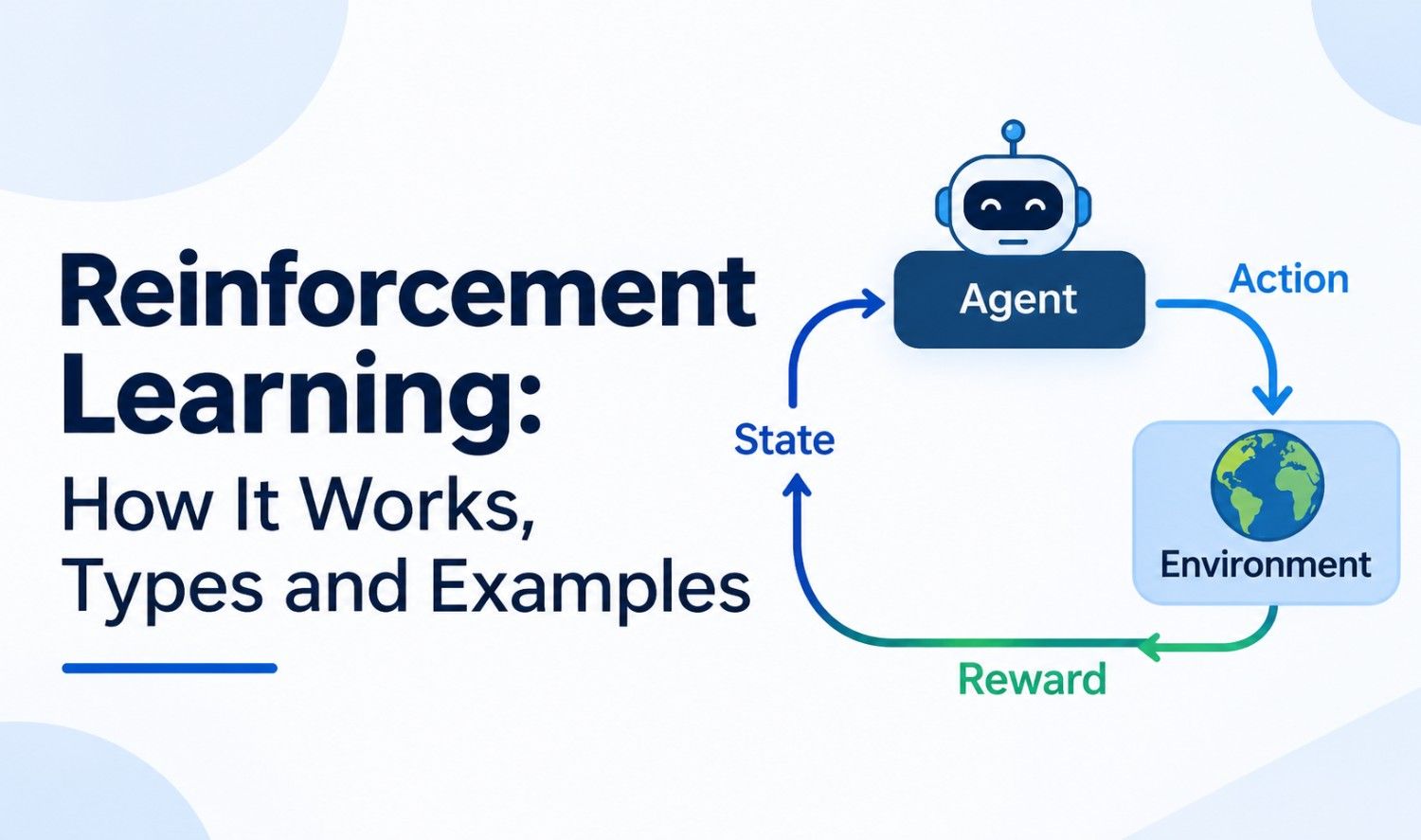

Reinforcement learning (RL) is a type of machine learning where an agent learns to make decisions by trying actions and getting rewards or penalties. Over many attempts, it figures out which actions lead to the best long-term results, without being told the right answer upfront.
Think about how you learned to ride a bike. Nobody handed you a manual with the perfect angle for every turn. You wobbled, fell, adjusted and slowly got better. Reinforcement learning works the same way, except the learner is software. In this guide, you’ll learn the key concepts, how the learning loop works, the main types and algorithms, and where RL shows up in the real world.
Key Takeaways
- Learning by trial and error: An agent takes actions, gets rewards and improves over time.
- Core parts: Agent, environment, state, action, reward, policy and value function.
- Different from supervised learning: RL learns from feedback on its actions, not from labeled answers.
- Popular algorithms: Q-learning, SARSA, DQN, policy gradients, actor-critic and PPO.
- Real impact: RL powered AlphaGo and helps tune chatbots like ChatGPT through RLHF.
What Is Reinforcement Learning?
Reinforcement learning is a branch of machine learning in which an agent learns by interacting with an environment. It takes an action, sees what happens and receives a reward signal. Its goal is to maximize total reward over time. IBM describes it as a process “in which autonomous agents learn to make decisions.”
What makes RL different is that nobody tells the agent which action is correct. It has to discover good behavior on its own. Two ideas sit at the heart of this:
- Trial and error: The agent tries different actions and learns from the results.
- Delayed reward: A good move now might only pay off much later, so the agent has to think long term.
Researchers usually describe RL problems using a Markov decision process (MDP). An MDP is a formal way to describe states, actions, rewards and how one state leads to the next. The standard textbook on the subject is Reinforcement Learning: An Introduction by Richard S. Sutton and Andrew G. Barto, which the authors offer free online.
You’ll sometimes see people search for “reinforced learning” or “reinforce learning.” They mean the same thing. The correct term is reinforcement learning, and in AI it’s often shortened to RL.
Key Concepts in Reinforcement Learning
Reinforcement learning is built on a handful of core concepts: the agent, the environment, states, actions, rewards, the policy and the value function. Once you understand how these pieces fit together, every RL algorithm makes more sense, because they all try to answer the same question: what should the agent do next?
Agent and Environment
The agent is the learner and decision-maker, such as a game-playing program or a robot. The environment is everything the agent interacts with, like the game board or the room the robot moves through.
State, Action and Reward
- State: A snapshot of the current situation, such as the position of pieces on a board.
- Action: A choice the agent can make, like moving left or picking up an object.
- Reward: A number that tells the agent how good or bad its last action was.
Policy
The policy is the agent’s strategy. It maps each state to an action, answering “In this situation, what do I do?” Training an RL agent is mostly about improving its policy.
Value Function
The value function estimates how much total reward the agent can expect from a state, or from taking an action in that state. Rewards tell the agent what’s good right now. Values tell it what’s good in the long run.
Exploration vs Exploitation
The agent faces a constant trade-off. It can exploit what it already knows to get a reward, or explore new actions that might turn out better. Too much exploitation and it gets stuck in habits. Too much exploration and it wastes time. Good RL balances both.
How Does Reinforcement Learning Work?
Reinforcement learning works as a repeating loop. The agent observes the current state, picks an action based on its policy, receives a reward and moves to a new state. It then updates its policy using that feedback. After thousands or millions of these loops, the agent learns which actions lead to the highest total reward.
Here’s the loop step by step:
- Observe: The agent looks at the current state of the environment.
- Act: It chooses an action using its current policy.
- Receive feedback: The environment returns a reward and a new state.
- Learn: The agent updates its policy or value estimates.
- Repeat: The loop continues until the task ends, then starts over.
Illustrative example: Imagine teaching a robot vacuum to clean a room. Each time it picks up dirt, it gets +1. Each time it bumps into furniture, it gets -1. When its battery runs out far from the charger, it gets -10. At first, it moves randomly. Over many runs, it learns to clean efficiently, avoid obstacles and head back to charge in time. This example is for illustration only and doesn’t describe a specific product.
Reinforcement Learning vs Supervised and Unsupervised Learning
Reinforcement learning in machine learning sits alongside two other main approaches. Supervised learning learns from labeled examples with correct answers. Unsupervised learning finds patterns in unlabeled data. Reinforcement learning learns from rewards earned through its own actions, so it fits problems where decisions happen in sequence and outcomes unfold over time.
| Supervised Learning | Unsupervised Learning | Reinforcement Learning | |
|---|---|---|---|
| Learns from | Labeled data | Unlabeled data | Rewards from actions |
| Goal | Predict the right answer | Find hidden patterns | Maximize long-term reward |
| Feedback | Correct answer for each example | None | Reward signal, often delayed |
| Example | Spam detection | Customer segmentation | Game-playing agents |
One common mix-up: model-free RL is not the same as unsupervised learning. Model-free means the agent learns without building a model of how the environment works. It’s still reinforcement learning, driven by rewards.
Types of Reinforcement Learning
The main types of reinforcement learning are model-based and model-free, value-based and policy-based, deep reinforcement learning and multi-agent reinforcement learning. These categories overlap, so one algorithm can belong to several at once. For example, DQN is model-free, value-based and deep all at the same time.
- Model-based RL: The agent builds a model of the environment and uses it to plan ahead. It can learn with fewer real attempts, but the model has to be accurate.
- Model-free RL: The agent learns directly from experience without a model. It’s simpler to apply but usually needs more trial and error.
- Value-based RL: The agent learns the value of actions, then picks the one with the highest value.
- Policy-based RL: The agent learns the policy directly, which works well when there are many possible actions.
- Actor-critic: A hybrid. The “actor” picks actions, while the “critic” judges how good they were.
- Deep reinforcement learning: Uses neural networks to handle complex inputs like images or game screens.
- Multi-agent RL: Several agents learn in the same environment, either working together or competing.
Common Reinforcement Learning Algorithms
The most common reinforcement learning algorithms are Q-learning, SARSA, Deep Q-Networks (DQN), policy gradient methods like REINFORCE, actor-critic methods and Proximal Policy Optimization (PPO). Each takes a different approach to improving the agent’s decisions, and the best choice depends on the problem, the size of the action space and the compute available.
| Algorithm | Type | Key Idea |
|---|---|---|
| Q-learning | Value-based, model-free | Learns the value of each action in each state |
| SARSA | Value-based, model-free | Like Q-learning, but learns from the actions it actually takes |
| DQN | Value-based, deep | Uses a neural network to estimate action values |
| REINFORCE | Policy gradient | Adjusts the policy toward actions that earned more reward |
| Actor-critic | Hybrid | Combines a policy (actor) with a value estimate (critic) |
| PPO | Policy gradient | Makes steady, limited policy updates for stable training |
A few of these deserve a closer look:
- Q-learning: One of the most widely taught RL algorithms. It keeps a table of “Q-values” that score each action in each state.
- DQN: In February 2015, Google DeepMind showed that DQN could learn to play 49 classic video games “provided only with the raw screen pixels, set of available actions and game score.” In more than half the games, it reached over 75% of a professional human player’s level.
- PPO: Proposed by John Schulman and colleagues in 2017 as “a new family of policy gradient methods for reinforcement learning.” It’s widely used because it trains reliably.
Reinforcement Learning Examples
Some of the best-known reinforcement learning examples are AlphaGo beating a world champion at Go, DQN learning Atari games from screen pixels and RLHF tuning large language models like ChatGPT. RL is also used in robotics, recommendation systems and resource management, where systems make many decisions in a row.
- AlphaGo: In March 2016, Google DeepMind’s AlphaGo beat world champion Lee Sedol 4-1 in Seoul. According to DeepMind, the match was “watched by over 200 million people worldwide.” AlphaGo first studied human games, then improved by playing different versions of itself thousands of times.
- RLHF in language models: Reinforcement learning from human feedback (RLHF) uses human rankings of model answers to train a reward model, then uses RL to tune the language model. In OpenAI’s InstructGPT research from 2022, human evaluators preferred outputs from a 1.3B parameter InstructGPT model over the 175B GPT-3.
- Robotics: Robots use RL to learn tasks like grasping and walking, often in simulation first.
- Recommendations: RL can help systems decide what content to show next based on user responses.
For a deeper look at real-world uses by industry, see our guide to reinforcement learning applications.
Benefits and Challenges of Reinforcement Learning
Reinforcement learning shines at problems where a system makes many decisions in a row and the best strategy isn’t obvious. It can find solutions humans didn’t think of. But it also has real challenges: it needs a lot of data and compute, rewards are hard to design and behavior learned in simulation doesn’t always carry over to the real world.
Benefits:
- No labeled data needed: The agent learns from rewards, not from a dataset of correct answers.
- Long-term thinking: RL optimizes for total reward, not just the next step.
- Adapts to change: Agents can keep learning as conditions shift.
- Finds new strategies: RL can discover approaches that humans hadn’t considered.
Challenges:
- Sample inefficiency: Agents often need huge numbers of attempts to learn.
- Reward design: A badly designed reward can lead the agent to “game” the system instead of solving the real task, a problem known as reward hacking.
- Sim-to-real gap: Skills learned in simulation may fail in messy real environments.
- Compute cost: Training complex agents takes significant computing power.
- Safety: Exploration can be risky when real equipment or people are involved.
Tools to Get Started With Reinforcement Learning
The easiest way to start with reinforcement learning is to use open source tools built for it. Gymnasium provides standard environments to train and test agents, Stable-Baselines3 offers ready-made algorithm implementations and PyTorch handles the neural networks. Pair these with Sutton and Barto’s textbook to learn the theory behind the code.
- Gymnasium: The Gymnasium project describes itself as “a maintained fork of OpenAI’s Gym library.” It’s the go-to source of test environments, from simple balancing tasks to classic games.
- Stable-Baselines3: “A set of reliable implementations of reinforcement learning algorithms in PyTorch,” including PPO, DQN and actor-critic methods.
- PyTorch: A popular deep learning framework used to build the neural networks behind deep RL.
- Sutton and Barto: The free textbook covers the math and ideas in depth.
A good first project is training a PPO agent on a simple Gymnasium environment like CartPole, where the goal is to keep a pole balanced on a moving cart.
If you’re thinking about applying RL or other machine learning methods to a business problem, our AI and ML development team can help you scope it.
Frequently Asked Questions
What is reinforcement learning in simple terms?
Reinforcement learning is a way for software to learn by trial and error. It tries actions, gets rewards or penalties and gradually learns which actions lead to the best results over time.
What is RL in AI?
RL stands for reinforcement learning. In AI, it refers to methods where an agent learns to make decisions by interacting with an environment and maximizing a reward signal, instead of learning from labeled examples.
What is a simple example of reinforcement learning?
A classic example is a game-playing agent. It plays the game over and over, earns points for good moves and loses points for bad ones, then slowly learns a winning strategy. AlphaGo is a famous real-world case.
How is reinforcement learning different from supervised learning?
Supervised learning learns from labeled data with the correct answer for each example. Reinforcement learning has no correct answers upfront. It learns from rewards it earns through its own actions.
Is ChatGPT trained with reinforcement learning?
Partly. OpenAI says it trained ChatGPT “using Reinforcement Learning from Human Feedback (RLHF), using the same methods as InstructGPT.” The model was first pretrained and fine-tuned, then refined with RLHF.
Is reinforced learning the same as reinforcement learning?
Yes. “Reinforced learning” and “reinforce learning” are common variations people search for, but the correct term is reinforcement learning. REINFORCE, in capital letters, is also the name of a specific policy gradient algorithm.
Which reinforcement learning algorithm is best?
There’s no single best algorithm. Q-learning suits small, simple problems. DQN works well for game-like tasks with visual inputs. PPO is a popular general-purpose choice because it trains reliably across many tasks.