
Reinforcement learning applications range from training AI chatbots and robots to designing computer chips, managing inventory and beating world champions at games. Reinforcement learning (RL) is a type of machine learning where an agent learns by trial and error, earning rewards for good actions and learning to avoid poor ones.
Think of it like training a dog with treats. You don’t explain the rules. You reward the behavior you want, and over time the dog figures out what works. RL does the same thing with software, but it can practice millions of times in a simulation. This guide covers 12 examples of reinforcement learning in the real world, how each one works, the main tools and where RL is the wrong choice.
Key Takeaways
- How it learns: An agent takes actions, gets rewards and improves its strategy over time.
- Major modern use: Chatbots like ChatGPT are fine-tuned with reinforcement learning from human feedback (RLHF).
- Proven wins: RL beat a Go world champion, designs Google’s TPU chips and found faster sorting code.
- Best fit: Problems with many sequential decisions and a clear way to score results.
- Main hurdle: RL usually needs a safe simulator or lots of interaction data.
What Is Reinforcement Learning?
Reinforcement learning is a machine learning method where an agent learns to make decisions by interacting with an environment. Each action earns a reward or penalty, and the agent’s goal is to maximize total reward over time. Unlike supervised learning, it doesn’t need labeled answers. It learns from the results of its own actions.
The field’s foundations earned Andrew Barto and Richard Sutton the 2024 ACM A.M. Turing Award “for developing the conceptual and algorithmic foundations of reinforcement learning.”
| Concept | What It Means | Example (Game Bot) |
|---|---|---|
| Agent | The learner that makes decisions | The AI player |
| Environment | The world the agent acts in | The game board |
| State | The current situation | Positions of all pieces |
| Action | A choice the agent can make | A move |
| Reward | Feedback on how good an action was | +1 for a win, -1 for a loss |
| Policy | The agent’s strategy | Which move to make in each position |
The agent balances two goals: exploring new actions to learn more, and exploiting actions it already knows work well.
Reinforcement Learning Applications at a Glance
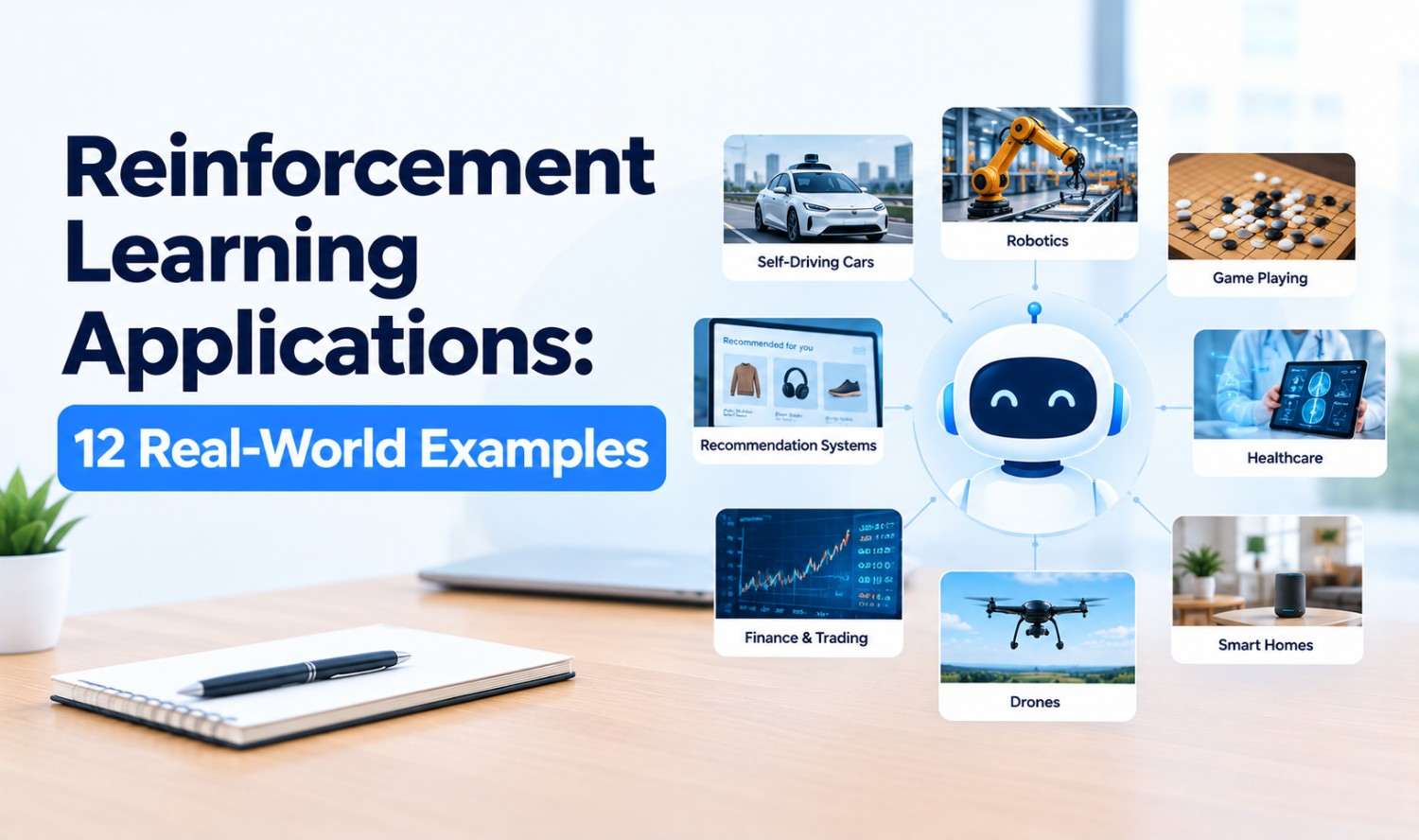
Reinforcement learning applications appear wherever a system must make a series of decisions and can measure how well it did. The most proven areas today are AI language models, games, robotics, chip design and algorithm discovery, with growing use in logistics, healthcare, finance and transportation.
| Industry | What RL Does | Real Example |
|---|---|---|
| AI and chatbots | Aligns models with human preferences | OpenAI InstructGPT (RLHF) |
| Games | Learns winning strategies | DeepMind AlphaGo |
| Robotics | Learns physical skills | OpenAI’s Rubik’s Cube robot hand |
| Autonomous driving | Learns driving behavior | “Learning to Drive in a Day” research |
| Chip design | Places components on a chip | Google DeepMind AlphaChip |
| Software | Discovers faster algorithms | Google DeepMind AlphaDev |
| Supply chain | Optimizes inventory orders | Amazon inventory research |
| Healthcare | Supports treatment and lab decisions | Research on treatment regimes and cell culture |
| Recommendations | Chooses what content to show | Streaming and e-commerce feeds |
| Finance | Tests trading and portfolio strategies | Research and in-house trading systems |
| Transportation | Adjusts traffic signals | Smart traffic research |
| Energy | Controls heating, cooling and grids | Building and grid control research |
12 Real-World Reinforcement Learning Applications
The examples below start with the most widely used and best-documented applications, then move to areas where RL is still mostly in research or early deployment. For each one, you’ll see what problem RL solves, how it works in plain terms and a real example where one is publicly documented.
1. Large Language Models and Chatbots (RLHF)
One of the most visible uses of reinforcement learning in AI today is fine-tuning chatbots. With reinforcement learning from human feedback (RLHF), people rank a model’s answers, a reward model learns those preferences, and RL trains the chatbot to give answers people prefer.
OpenAI used RLHF for its InstructGPT models in early 2022 and for ChatGPT at its launch in November 2022. Human raters preferred answers from the 1.3-billion-parameter InstructGPT model over the 175-billion-parameter GPT-3, despite it having more than 100 times fewer parameters, according to OpenAI. The same idea now shapes many AI assistants and agents. You can see how those agents are built in our guide to AI agent platforms.
2. Games
Games are RL’s classic testing ground because the rules are clear and the score is easy to measure. An agent can play millions of games against itself and keep the strategies that win.
DeepMind’s AlphaGo beat world champion Lee Sedol 4-1 in Seoul in March 2016, a match watched by over 200 million people. According to Google DeepMind, AlphaGo improved through reinforcement learning by playing thousands of games against versions of itself.
3. Robotics
Robots must learn skills like grasping, walking and handling objects, which are hard to program by hand. RL lets a robot practice in simulation and learn from success and failure.
In 2019, OpenAI trained a robot hand to solve a Rubik’s Cube. Its control networks were trained entirely in simulation with reinforcement learning, using a technique called Automatic Domain Randomization that varied the simulated conditions so the skills transferred to a real robot.
4. Autonomous Driving
Driving involves constant decisions about steering, speed and braking. RL can learn driving behaviors by rewarding safe progress, usually in simulators first because real-world mistakes are costly.
A 2018 paper titled “Learning to Drive in a Day” described “the first application of deep reinforcement learning to autonomous driving.” The car learned to follow a lane from a single camera in a handful of training runs, with its reward based on how far it drove before a safety driver took over.
5. Chip Design
Placing millions of components on a chip is a huge puzzle with countless possible layouts. RL treats chip layout like a game, placing one block at a time and earning rewards for better designs.
Google DeepMind’s AlphaChip is a reinforcement learning method for chip layouts. DeepMind says AlphaChip “has generated superhuman chip layouts used in every generation of Google’s TPU,” the custom chips that power Google’s AI.
6. Algorithm Discovery
RL can even improve the code computers run. By rewarding programs that are both correct and fast, an agent can discover new ways to perform basic tasks.
In 2023, Google DeepMind’s AlphaDev used reinforcement learning to discover sorting algorithms up to 70% faster for short sequences. The new routines were added to LLVM’s libc++, a widely used standard C++ library.
7. Supply Chain and Inventory
Inventory decisions are a chain of choices: how much to order, when and where. Order too little and you lose sales. Order too much and you waste money. RL can learn ordering policies that balance both.
At NeurIPS 2022, Amazon principal scientist Dhruv Madeka presented work on deep reinforcement learning for real-world inventory control. The talk reported that learned policies matched or beat classical methods in both simulations and real-world deployments.
8. Healthcare
Some medical decisions happen in sequence, like adjusting treatment as a patient responds. RL can help model these decisions, though it’s mostly used in research because patient safety comes first.
A 2024 systematic review in the journal Sensors covers RL for optimizing cell cultures used in therapy development. It also notes earlier research on dynamic treatment regimes, medical diagnosis, health resource scheduling and drug discovery.
9. Recommendations and Personalization
Recommendation systems decide what to show you next: a video, a product or an article. RL helps them think beyond the next click and focus on long-term satisfaction, such as whether you keep coming back.
A related technique, bandit algorithms, tests which content or images work best for each user and learns from the results as people respond.
10. Finance and Trading
Trading is a sequence of buy, sell and hold decisions in a constantly changing market. RL can learn strategies that aim to maximize returns while managing risk, usually tested on historical data first.
In practice, finance firms tend to use RL carefully, often in testing and in-house systems, because markets change and past patterns don’t always repeat.
11. Traffic Signal Control
Traffic lights that run on fixed timers can’t react to real conditions. RL-based controllers treat each light as an agent that changes signal timing based on live traffic, with rewards for shorter waits and queues.
It remains an active research area for smart cities, with most work still in simulation and pilots.
12. Energy and Industrial Control
Heating, cooling and power grids need constant small adjustments. RL is being researched to control these systems more efficiently, with rewards for lower energy use within safe limits.
A common example is Google’s data center cooling. DeepMind reported a 40% cut in cooling energy in 2016, and its 2018 system directly controlled cooling with about 30% average savings. DeepMind describes deep neural networks that predict outcomes and choose actions, so it’s best seen as a close cousin of RL rather than a textbook case.
Reinforcement Learning vs Supervised and Unsupervised Learning
Reinforcement learning differs from the other two main types of machine learning in how it learns. Supervised learning learns from labeled examples. Unsupervised learning finds patterns in unlabeled data. Reinforcement learning learns from rewards earned by its own actions, which makes it best suited to decision-making problems.
| Feature | Supervised Learning | Unsupervised Learning | Reinforcement Learning |
|---|---|---|---|
| Learns from | Labeled examples | Unlabeled data | Rewards and penalties |
| Goal | Predict the right answer | Find patterns or groups | Maximize long-term reward |
| Example | Spam filter | Customer segmentation | Game-playing agent |
| Feedback | Immediate, correct answer given | None | Delayed, through rewards |
Benefits and Challenges of Reinforcement Learning
Reinforcement learning’s biggest benefit is that it can find strategies humans never thought of, without needing labeled answers. Its biggest challenge is that it needs lots of trial and error, which is slow, expensive or risky outside a simulator. Reward design is also tricky, because agents optimize exactly what you reward.
Benefits:
- Learns complex strategies: It can master long sequences of decisions.
- No labeled data needed: It learns from outcomes instead.
- Adapts over time: It can keep improving as conditions change.
- Finds new solutions: AlphaGo and AlphaDev both found approaches experts hadn’t used.
Challenges:
- Data and compute heavy: Agents may need millions of practice runs.
- Simulation gap: Skills learned in simulation don’t always transfer to the real world.
- Reward design: A poorly designed reward can teach the wrong behavior.
- Safety: Trial and error isn’t acceptable in high-stakes settings without safeguards.
- Explainability: It can be hard to understand why an agent chose an action.
Popular Reinforcement Learning Tools and Platforms
The most popular reinforcement learning tools are open source Python libraries, so you can start experimenting for free. Gymnasium provides standard environments for training and testing agents. Stable-Baselines3 offers ready-made RL algorithms. RLlib, part of Ray, scales RL training across many machines for production workloads.
| Tool | What It Does |
|---|---|
| Gymnasium | “A maintained fork of OpenAI’s Gym library” with standard training environments |
| Stable-Baselines3 | “Reliable implementations of reinforcement learning algorithms in PyTorch” |
| RLlib (Ray) | “An open source library for reinforcement learning,” built for scalable workloads |
A typical starting path is to learn the basics in Gymnasium, test algorithms like PPO or DQN with Stable-Baselines3, then move to RLlib when you need scale.
How Businesses Can Use Reinforcement Learning
Businesses can use reinforcement learning when they face repeated, sequential decisions with a measurable outcome, such as pricing, inventory, scheduling, routing or personalization. The key is having a safe way to experiment, usually a simulator built from historical data, before letting an agent make real decisions.
Before starting an RL project, ask:
- Is it a sequence of decisions? One-off predictions are usually better solved with supervised learning.
- Can you measure success? You need a clear reward, like profit, wait time or customer retention.
- Can you simulate it? A simulator lets the agent practice without real-world risk.
- Do you have enough data? Historical data helps build simulators and starting policies.
- Is there a human in the loop? Keep oversight and limits in place at first.
Frequently Asked Questions
What are the main applications of reinforcement learning?
The main reinforcement learning applications include training AI chatbots with RLHF, game-playing AI, robotics, autonomous driving research, chip design, algorithm discovery, inventory management, recommendations, finance, traffic control and energy systems.
Is ChatGPT trained with reinforcement learning?
Yes. OpenAI says it trained ChatGPT using reinforcement learning from human feedback (RLHF) when it launched in November 2022. It used the same method for its earlier InstructGPT models.
What is an example of reinforcement learning in daily life?
AI chatbots and recommendation feeds are everyday examples. Chatbots are refined with RLHF, and many apps use related learning methods to decide what content to show you.
Which industries use reinforcement learning the most?
The best-documented uses are in technology, for AI models, chip design and software. RL is also used and researched in logistics, robotics, finance, healthcare and transportation.
How is reinforcement learning different from supervised learning?
Supervised learning learns from labeled examples with correct answers. Reinforcement learning learns from rewards earned through its own actions, without being told the right answer.
Is reinforcement learning used in self-driving cars?
Yes, mainly in research and simulation. A 2018 paper showed a car learning to follow a lane with deep reinforcement learning in a handful of training runs.
What are the limitations of reinforcement learning?
RL needs lots of trial and error, often requires a simulator, can learn the wrong behavior from a poorly designed reward, and can be hard to explain.