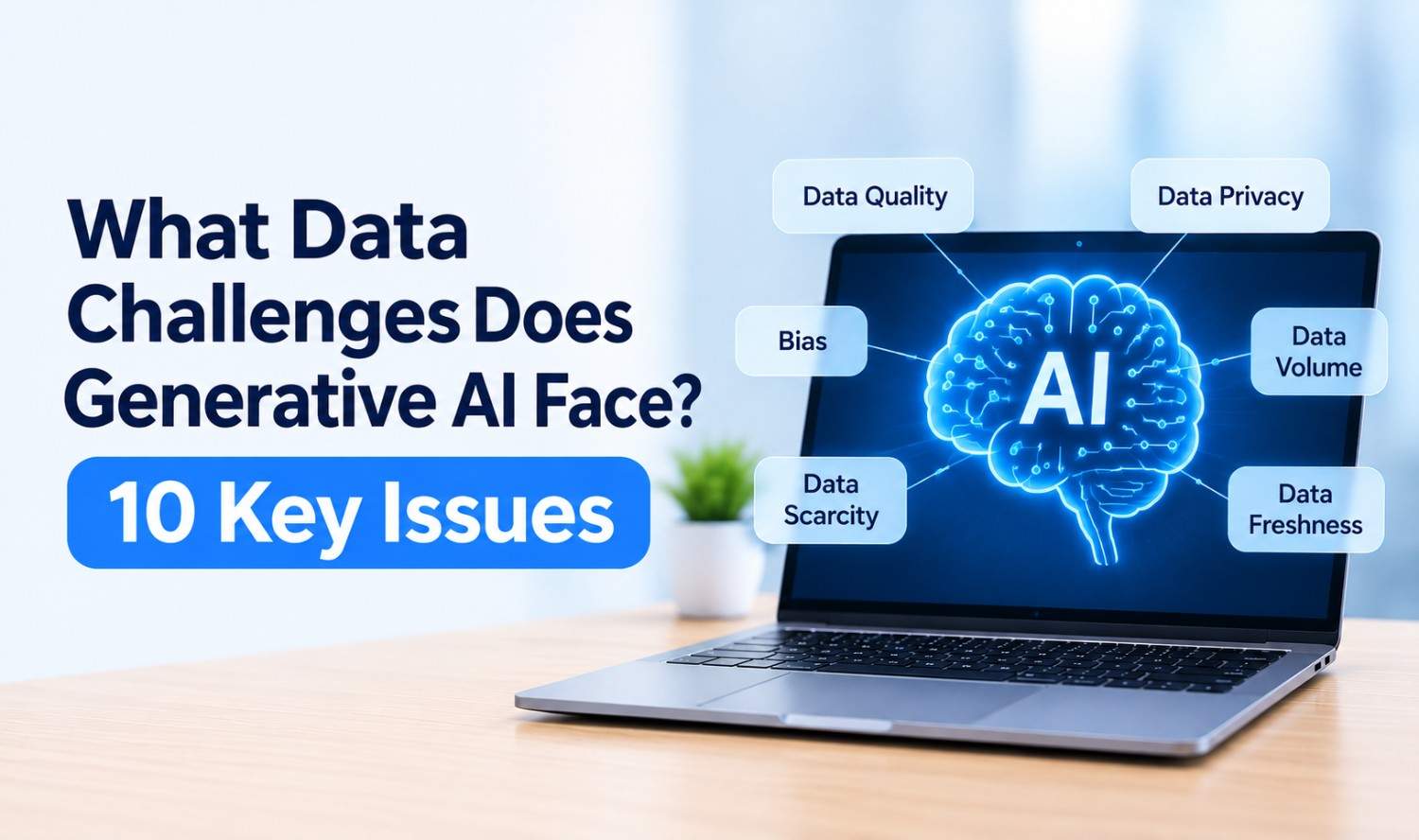

What challenges does generative AI face with respect to data? The biggest are poor data quality, bias, privacy risks, copyright disputes, a shrinking supply of high-quality human-written text, outdated information, data poisoning, model collapse from AI-generated content, messy business data and growing regulation. Each one affects how accurate, fair and safe AI outputs are.
Generative AI is a bit like a chef. Give it fresh, well-labeled ingredients and it can make something great. Give it spoiled or mislabeled ones and even the best recipe fails. This guide explains each data challenge in plain language, shows what the research says and covers practical ways to reduce the risks.
Key Takeaways
- Data decides output: A model can only be as good as the data it learns from.
- Business data is a big gap: Gartner says 63% of organizations lack AI-ready data practices or aren’t sure.
- Supply is limited: Researchers estimate high-quality human text could be fully used between 2026 and 2032.
- Small attacks matter: Research shows as few as 250 malicious documents can backdoor a model.
- Fixes exist: Data governance, retrieval from trusted sources and human review reduce most risks.
Why Data Matters So Much to Generative AI
Generative AI learns patterns from huge amounts of data, then uses those patterns to create new text, images or code. It doesn’t understand the world the way people do. It reflects what it was trained on. So if the data is wrong, biased, outdated or incomplete, the outputs will be too.
The scale is enormous. The US Government Accountability Office (GAO) notes that generative AI typically requires a large training dataset, “ranging from millions to trillions of data points.” At that size, small problems in the data can spread into millions of answers.
That’s why data shapes almost every part of a model’s behavior, from the facts it gets right to the tone it uses and the gaps it can’t fill. A model trained mostly on English web pages, for example, will usually perform worse in other languages and in specialized fields with little public content.
Training Data vs Your Business Data
Generative AI data challenges show up in two places. The first is the training data that model makers use to build models like ChatGPT or Claude. The second is your own business data that you connect to those models. Most companies can’t change the training data, but they fully control their own data.
| Training Data | Your Business Data | |
|---|---|---|
| Who controls it | The model maker | Your company |
| Examples | Web pages, books, code, licensed content | Documents, CRM records, help articles, policies |
| Main risks | Bias, copyright, outdated knowledge, scarcity | Messy formats, missing context, privacy, access control |
| What you can do | Choose models carefully, test outputs | Clean, organize, govern and secure it |
What Challenges Does Generative AI Face With Respect to Data?
Generative AI faces ten main data challenges, covering both the data used to train models and the data businesses feed into them. They range from basic quality problems to new risks like poisoning attacks and model collapse. The challenges below are grouped from the most common everyday issues to newer, research-driven concerns.
1. Poor Data Quality
Incomplete, duplicated or incorrect data leads to incorrect answers. It’s the classic “garbage in, garbage out” problem. In business settings, outdated documents, conflicting versions and missing fields are common causes of wrong or confusing AI responses.
2. Bias in Training Data
If some groups, languages or viewpoints are underrepresented in the data, a model can produce unfair or one-sided results. NIST lists “Harmful Bias or Homogenization” among the 12 risks of generative AI in its Generative AI Profile (NIST AI 600-1).
3. Privacy and Personal Data
Training data and user prompts can contain personal information. NIST describes the data privacy risk as “leakage and unauthorized use, disclosure, or de-anonymization of biometric, health, location, or other personally identifiable information or sensitive data.” Employees pasting customer data into public AI tools adds to the risk.
4. Copyright and Data Ownership
Many models were trained on content collected from the web, which raises questions about permission and payment. NIST’s intellectual property risk covers replicating “copyrighted, trademarked, or licensed content without authorization.” The US Copyright Office released a pre-publication report on generative AI training in May 2025, and the law is still developing. This is general information, not legal advice.
5. Running Out of High-Quality Data
The supply of good human-written text is limited. Research group Epoch AI estimates the stock of quality public human text at about 300 trillion tokens and projects that AI models could fully use it between 2026 and 2032. Specialized fields, like medicine or law, have even less high-quality data available.
6. Outdated Data and Knowledge Cutoffs
Most models learn from data collected up to a certain date. After that, they don’t know about new products, prices, laws or events unless they’re connected to fresh sources. This can lead to confident but outdated answers.
7. Data Poisoning and Security Attacks
Attackers can plant harmful content in data a model learns from. OWASP lists “Data and Model Poisoning” in its Top 10 for LLM applications, where training or fine-tuning data is “manipulated to introduce vulnerabilities” such as hidden backdoors or bias. A 2025 study by Anthropic, the UK AI Security Institute and the Alan Turing Institute found that as few as 250 malicious documents could backdoor a model “regardless of model size or training data volume.”
8. Model Collapse From AI-Generated Data
As more online content is created by AI, future models may be trained on it. Think of making a photocopy of a photocopy: each copy loses detail. A 2024 study in Nature found that “indiscriminate use of model-generated content in training causes irreversible defects,” with models gradually losing rare but important information.
9. Messy, Unstructured Business Data
Company knowledge is often scattered across PDFs, emails, spreadsheets and old systems. That makes it hard for AI to find and use. Gartner found that 63% of organizations lack AI-ready data management practices or aren’t sure if they have them, and it predicts organizations will abandon 60% of AI projects unsupported by AI-ready data through 2026.
10. Regulation and Data Governance
New rules are raising the bar for data. The EU AI Act requires training, validation and testing data for high-risk AI systems to be “relevant, sufficiently representative, and to the best extent possible, free of errors and complete.” Companies need clear records of where data comes from and how it’s used. Existing privacy laws and industry rules still apply to any personal data you feed into AI tools.
Generative AI Data Challenges at a Glance
The table below summarizes the ten generative AI data challenges, the main risk each one creates and the most practical way to reduce it. Use it as a quick checklist when you plan or review a generative AI project, especially before connecting a model to customer-facing tools or sensitive company information.
| Challenge | Main Risk | How to Reduce It |
|---|---|---|
| Poor data quality | Wrong answers | Clean, deduplicate and update sources |
| Bias | Unfair or one-sided outputs | Test outputs across groups, diversify data |
| Privacy | Leaked personal data | Remove or mask sensitive data, set usage rules |
| Copyright | Legal disputes | Use licensed or owned data, review outputs |
| Data scarcity | Weaker models in niche areas | Use high-quality domain data, careful synthetic data |
| Outdated data | Stale answers | Connect models to current, trusted sources |
| Data poisoning | Hidden backdoors or bias | Vet data sources, monitor model behavior |
| Model collapse | Loss of rare information | Keep human-created data in the mix |
| Messy business data | Failed AI projects | Organize, label and govern company data |
| Regulation | Fines and compliance gaps | Document data sources and governance |
How to Overcome Generative AI Data Challenges
You can reduce most generative AI data challenges with better data management, not just better models. Start by organizing and cleaning the data you control, connect AI to trusted and current sources, protect sensitive information, and keep people involved in reviewing important outputs. These steps lower risk and improve accuracy at the same time.
Practical steps:
- Build a data inventory: Know what data you have, where it lives and who owns it.
- Clean and update sources: Remove duplicates and outdated documents before connecting them to AI.
- Use retrieval from trusted sources: Retrieval-augmented generation (RAG) lets a model pull answers from your approved, current documents instead of relying only on its training data.
- Protect sensitive data: Mask personal information and set clear rules for what staff can share with AI tools.
- Control access: Make sure the AI only sees data each user is allowed to see.
- Test for bias and accuracy: Check outputs regularly, especially for high-stakes uses.
- Follow a framework: NIST AI 600-1 offers a structured way to manage generative AI risks.
- Keep humans in the loop: Review AI outputs before they reach customers or drive decisions.
Giving AI the right context about your business is a big part of this. Our guide to AI business context refinement explains how to do it well.
Does More Data Always Make Generative AI Better?
No, more data doesn’t always make generative AI better. Quality, relevance and diversity matter as much as volume. Adding low-quality, biased, poisoned or AI-generated content can actually make a model worse. A smaller set of accurate, well-organized data often beats a huge pile of messy information.
This is especially true for businesses. A chatbot connected to 50 accurate, current help articles will usually give better answers than one connected to thousands of outdated and conflicting files. If you’re building a generative AI tool on your own data, a generative AI development team can help you prepare and connect that data safely.
Frequently Asked Questions
What challenge does generative AI face with respect to data?
The main challenge is getting enough high-quality, unbiased, legal and current data. Related issues include privacy, copyright, data poisoning, model collapse and messy business data that isn’t ready for AI.
Why is data quality important for generative AI?
Generative AI learns from data and reflects its patterns. Poor-quality data leads to wrong, biased or confusing outputs, no matter how advanced the model is.
Is generative AI running out of training data?
It could. Epoch AI estimates that models could fully use the available stock of quality human-written public text between 2026 and 2032, which is why researchers are exploring synthetic data and other options.
What is model collapse?
Model collapse happens when AI models are trained on content created by other AI models. A 2024 study in Nature found this causes irreversible defects, as models lose rare but important information over time.
What is data poisoning in AI?
Data poisoning is when someone deliberately adds harmful or misleading content to data a model learns from, creating hidden backdoors or biases. Research shows as few as 250 malicious documents can be enough.
How does generative AI affect data privacy?
Personal information in training data or user prompts can be exposed or misused. Businesses should mask sensitive data, limit what staff share with AI tools and choose providers with clear data policies.
How can businesses prepare their data for generative AI?
Inventory your data, clean and update it, organize it into trusted sources, protect sensitive information, set access controls and connect AI to approved content using methods like RAG.