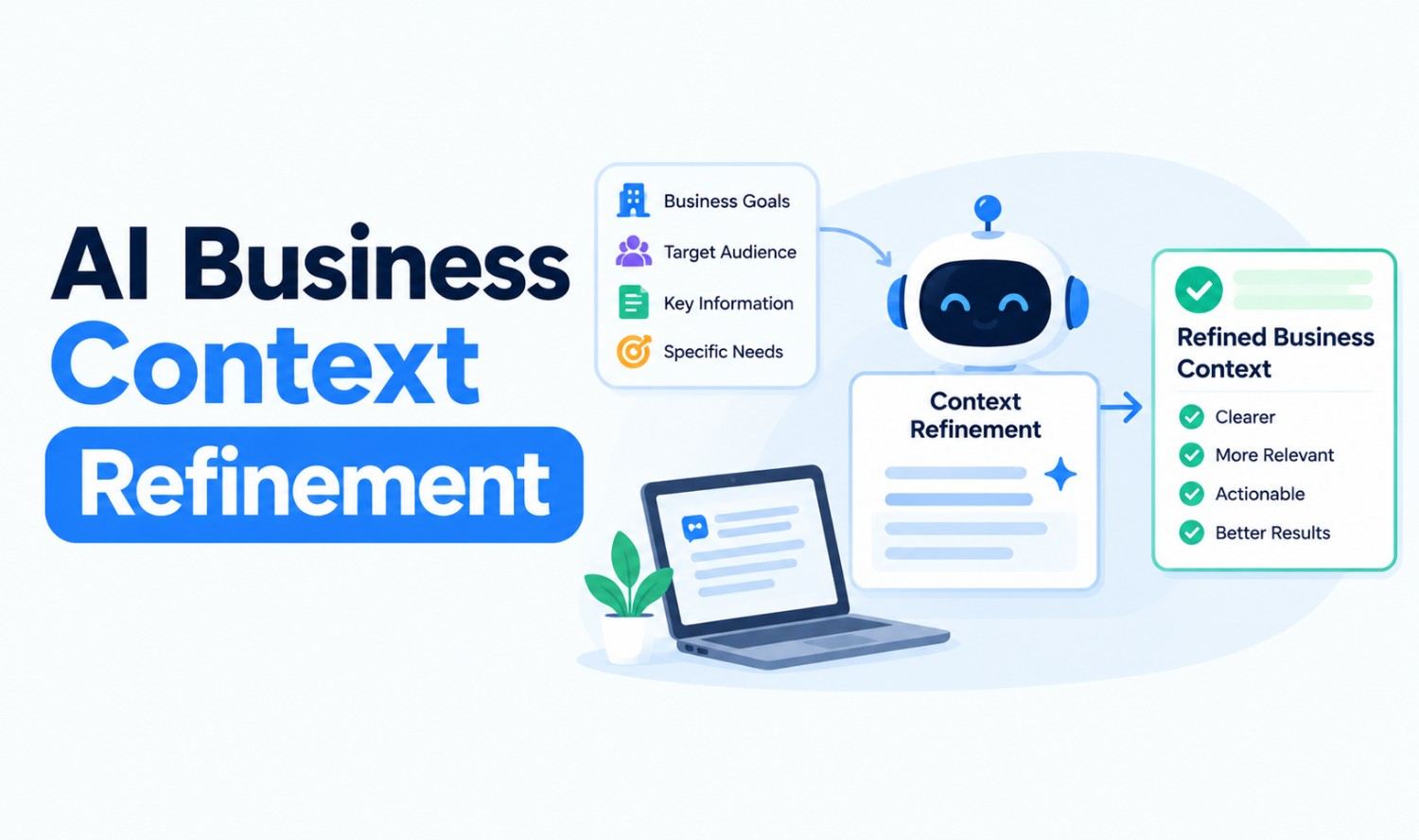

AI business context refinement is the ongoing process of selecting, organizing, testing and updating the company information an AI system uses, such as your policies, products, pricing, customer data and examples, so its answers fit your business instead of sounding generic.
Most AI tools are trained on the public internet. They know a lot about the world and nothing about your return policy, your service areas or the way your team talks to customers. Context refinement closes that gap without retraining the model. This guide explains the four types of business context, a 7-step refinement process, how to validate the results and how to keep context current as your business changes.
What Is AI Business Context Refinement?
AI business context refinement means giving an AI system the right company knowledge, in the right format, at the right time, then improving it based on results. AI business context is everything a model needs to act correctly for your company: rules, facts, live data, terminology and examples of good answers.
Context refinement is often confused with two other ways of customizing AI:
| Approach | What It Changes | Best For | Effort |
|---|---|---|---|
| Prompt engineering | The wording of a single request | One-off tasks | Low |
| Context refinement | The business information the AI receives | Ongoing, business-specific accuracy | Medium |
| Fine-tuning | The model’s internal weights, through extra training | Specialized style or tasks at scale | High |
For most small and midsize businesses, context refinement delivers the biggest improvement for the least cost, because it works with the AI tools you already use.
Why Generic AI Misses Your Business Needs
Generic AI misses your business needs because it fills gaps with general knowledge. When it doesn’t know your rules, it guesses, and those guesses can sound confident and still be wrong. NIST calls this “confabulation,” when AI systems “generate and confidently present erroneous or false content in response to prompts.”
Common signs your AI lacks business context:
- Wrong policies: It quotes a 30-day return window when yours is 14 days.
- Off-brand tone: Replies sound like a textbook, not your team.
- Missing details: It doesn’t know your service areas, hours or product names.
- Outdated facts: It repeats last year’s pricing.
- Unsafe actions: It promises refunds or discounts it isn’t allowed to offer.
The data problem is widespread. Gartner predicts that “through 2026, organizations will abandon 60% of AI projects unsupported by AI-ready data,” and found that 63% of organizations either don’t have or aren’t sure they have the right data management practices for AI. Context refinement is how you turn scattered business knowledge into AI-ready input.
The Four Types of Business Context
Business context comes in four types, and each one needs different handling: stable rules, live data, examples and constraints. Separating them makes your AI more accurate, easier to update and much simpler to troubleshoot when an answer goes wrong or a policy changes.
| Type | What It Includes | How Often It Changes | How to Provide It |
|---|---|---|---|
| Stable rules | Policies, processes, brand voice, terminology | Occasionally | Written instructions or a system prompt |
| Live data | Order status, inventory, account details, schedules | Constantly | Retrieved from your systems at the moment of use |
| Examples | Sample questions with ideal answers | When policies change | A small, curated set inside the instructions |
| Constraints | What the AI must never do, and when to hand off | Rarely | Clear “do not” rules and escalation paths |
Mixing these types is a common mistake. Pasting live prices into a static prompt, for example, guarantees the AI will eventually quote an old price.
How to Refine Business Context for AI: 7 Steps
Refining business context follows a repeatable process: start with the decisions the AI must make, gather only the information those decisions need, organize it clearly, remove what’s stale, then test and improve. These seven steps work whether you use a chatbot, an AI agent or a writing assistant.
- Start with decisions: List what the AI must decide or answer, such as “Can this order be returned?” Build context around those decisions, not around whole documents.
- Build a context inventory: For each source, record what it covers, who owns it, how current it is and who can access it.
- Separate rules from live data: Put stable policies in written instructions, and connect live data from your systems instead of copying it.
- Write rules as clear decisions: Replace vague prose with direct rules, such as “If the order is over 14 days old, offer store credit, not a refund.”
- Remove stale and conflicting information: Delete old policies instead of adding new ones below them. Conflicting context produces inconsistent answers.
- Keep it lean: Anthropic recommends finding “the smallest possible set of high-signal tokens that maximize the likelihood of some desired outcome.” Too much context can reduce accuracy.
- Add a few strong examples: Use a small set of varied, realistic examples rather than trying to cover every edge case.
Anthropic’s guide to context engineering also suggests starting with minimal instructions and adding more only when you see the AI fail. That keeps context focused on real problems.
AI Business Context Validation: How to Test It
AI business context validation checks whether the AI’s answers are correct for your business, not just plausible. You test the AI with real questions, compare its answers with your own policies and records, and trace any errors back to missing, outdated or unclear context.
A simple validation process:
- Use real questions: Pull actual customer emails, chats and edge cases. Include messy, incomplete questions, not just clean examples.
- Check against your records: Compare each answer with your current policies, prices and product facts.
- Trace failures: For each wrong answer, ask whether context was missing, stale, conflicting or unclear.
- Test after every change: Re-run your test set whenever you update context, so a fix in one place doesn’t break another.
Metrics worth tracking:
| Metric | What It Shows |
|---|---|
| Answer accuracy | Share of test answers that match your policies |
| Escalation accuracy | Whether the AI hands off the right cases to people |
| Policy compliance | How often it stays within rules and limits |
| Regression rate | Whether updates break answers that used to be correct |
Example: Refining a Support Chatbot’s Context
The example below is an illustration of how context refinement changes a typical small-business support chatbot. It walks through the original problem, the specific context changes the team made and the expected improvement, without any invented performance numbers or results.
Before refinement: An online furniture store connects a chatbot to its full help center, 200 pages of old and new articles. Customers ask, “Can I return a sofa after three weeks?” The bot finds an outdated 30-day policy and says yes, even though the current policy is 14 days for large items.
Refinement steps:
- Decision first: The team lists the top 20 questions customers ask, including returns, delivery and assembly.
- Clean sources: They delete outdated return articles and keep one current policy page.
- Clear rules: They add a rule: “Large items can be returned within 14 days. After that, offer an exchange or store credit.”
- Live data: Order dates now come from the order system, so the bot can calculate whether an order is eligible.
- Handoff rule: Damaged-item claims go to a person.
After refinement: The bot checks the order date, applies the 14-day rule and offers the right alternative. When the return policy changes next season, the team updates one page and re-runs its test questions.
Organizational Context Adaptation: Keeping Context Current
Organizational context adaptation means updating your AI’s business context as the company changes. New products, prices, policies, locations and team structures all change what “correct” looks like. If context doesn’t change with them, accuracy quietly falls even though the AI itself hasn’t changed.
Triggers that should prompt a context update:
- New or retired products and services
- Price or promotion changes
- Policy updates, such as returns, warranties or shipping
- New locations or service areas
- New regulations affecting what you can say or do
- Recurring wrong answers spotted in reviews or complaints
Treat context like a product release. Keep versions, note what changed and why, test before going live, and assign an owner for each source. Beyond trigger-based updates, set a regular review schedule that fits how often your business changes.
Context refinement is one part of governing AI well. For the bigger picture, including risk levels, ownership and US rules, see our guide to AI contextual governance for business evolution and adaptation.
Tools and Methods for Context Refinement
The right tools depend on how much context you manage and how often that context changes. Small teams can start with built-in AI features, while growing businesses usually need retrieval systems, testing and secure connections to live business data.
- Custom instructions: Tools like ChatGPT let you share standing context. OpenAI says custom instructions “allow you to share anything you’d like ChatGPT to consider in its response.”
- Knowledge bases: Upload approved documents, such as policies and product sheets, to the AI tool or chatbot platform you use.
- Retrieval-augmented generation (RAG): The AI searches your approved content and uses the most relevant pieces to answer. The method was introduced in a 2020 NeurIPS research paper by Lewis and colleagues.
- Model Context Protocol (MCP): The official MCP documentation describes it as “an open-source standard for connecting AI applications to external systems,” like “a USB-C port for AI applications.” It lets AI access live data and tools safely.
If you need AI grounded in your own data and connected to your systems, our generative AI development team builds RAG assistants and knowledge systems around your business context.
Common Mistakes to Avoid
The most common context refinement mistakes are giving the AI too much information, letting it go stale, mixing rules with live data and skipping testing. Each one leads to confident but wrong answers that slowly erode customer trust and create extra work for your team.
- Dumping every document: More context isn’t better. It often confuses the AI.
- Keeping old policies: Outdated pages compete with current ones.
- Copying live data into prompts: Prices and stock levels go stale fast.
- Vague instructions: “Be helpful with returns” gives the AI nothing concrete to apply.
- No testing: Changes that fix one answer can break another.
Frequently Asked Questions
What is AI business context refinement?
It’s the ongoing process of selecting, organizing, testing and updating the company information an AI system uses, such as policies, products, pricing and examples, so its answers are accurate and specific to your business.
What does AI business context mean?
AI business context is the company-specific knowledge an AI needs to act correctly: rules, facts, live data, terminology and examples of good answers. Without it, AI relies on general knowledge and guesses.
How is context refinement different from fine-tuning?
Context refinement changes the information the AI receives when it answers. Fine-tuning changes the model itself through extra training. Context refinement is usually faster, cheaper and easier to update.
How do you validate AI business context?
Test the AI with real customer questions, compare answers with your current policies and records, trace errors back to missing or outdated context, and re-test after every change.
How often should AI business context be updated?
Update it whenever products, prices, policies or regulations change, and also on a regular schedule that matches how often your business changes. Assign an owner to each source so updates don’t get missed.
Do small businesses need context refinement?
Yes. Even a simple chatbot gives better answers with a clean policy page, a few clear rules and good examples. Small businesses can start with built-in custom instructions and knowledge bases.