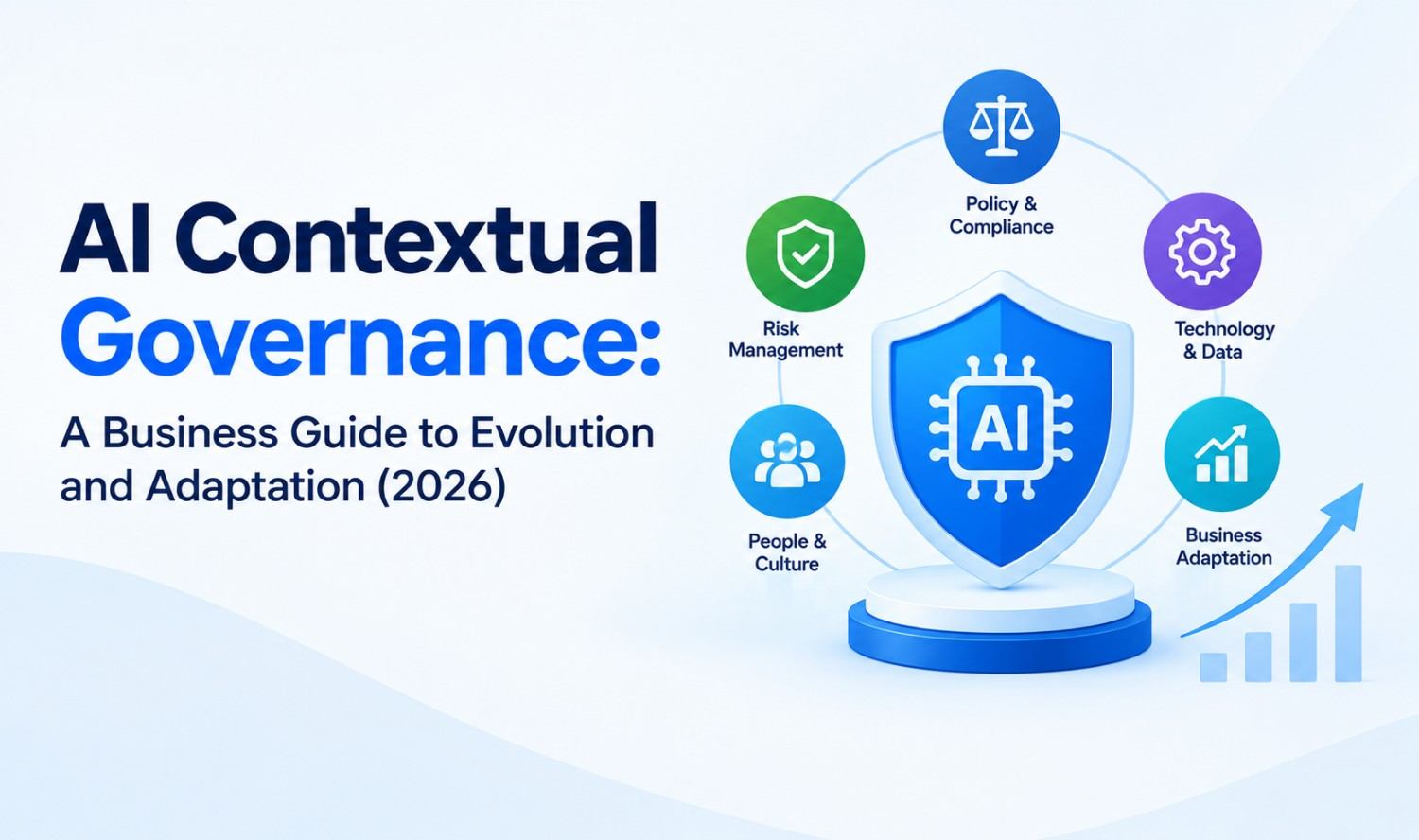

AI contextual governance means matching the oversight of each AI system to how it is actually used: its purpose, users, data, decision power and the cost of a mistake. Instead of one rulebook for every tool, a low-risk writing assistant gets light controls, while an AI agent that approves refunds or screens job applicants gets strict ones. As the business evolves, the governance adapts with it.
This guide explains AI contextual governance for business evolution and adaptation in plain terms. It covers the core ideas, the US rules that shape your context, a framework built on the US government’s own AI risk guidance, the metrics to track, and a 90-day rollout plan sized for small and mid-size businesses.
What Is AI Contextual Governance?
AI contextual governance is an approach to AI oversight where controls depend on the context each system operates in, not on a single policy applied to everything. Company-wide principles still set the baseline. On top of that, each AI system gets controls proportionate to its purpose, users, data, autonomy and potential harm.
The idea isn’t new jargon for its own sake. The NIST AI Risk Management Framework, released by the US National Institute of Standards and Technology in January 2023, organizes AI risk work into four functions. One of them, Map, exists specifically to establish “the context to frame risks related to an AI system.”
To understand a system’s context, answer eight questions:
- What business purpose does it serve?
- Who uses it, and who is affected by its output?
- What data can it access?
- What decisions does it inform or make?
- How much can it do on its own?
- What happens if it gets something wrong?
- Which laws or industry rules apply?
- Who is accountable for it?
An AI contextual governance solution, whether it’s a spreadsheet, a governance platform or a custom system, is simply a way to record those answers, apply the right controls and keep both up to date. Over time, that record becomes a form of business-specific contextual intelligence: a clear understanding of where each AI system is safe to rely on and where it isn’t.
Contextual Business Reality: Why the Same AI Carries Different Risk
Contextual business reality is the real-world setting an AI system operates in, and it often differs from the setting the system was designed for. A model’s technical performance says little about whether it’s appropriate in a given workflow. The contextual truth is simple: risk comes from the combination of system, use case and impact.
Consider one AI model used three ways:
| Use Case | Who’s Affected | Cost of a Mistake | Governance Level |
|---|---|---|---|
| Drafting internal meeting summaries | Employees | Low; a person reviews it | Light: usage guidelines, spot checks |
| Answering customer questions on your website | Customers | Medium; wrong information, lost trust | Moderate: approved knowledge sources, escalation to humans, disclosure |
| Screening job applicants | Candidates | High; unfair outcomes, legal exposure | Strict: bias testing, human review, audit trail, candidate notice |
Same technology, three very different governance needs. That’s the core argument for contextual governance.
Why Traditional AI Governance Falls Short
Traditional governance was built for predictable software with fixed rules, reviewed in periodic audits. AI behaves differently. Its outputs are probabilistic, its performance can shift after launch, and its role inside a business often grows without anyone formally deciding it should.
Three problems show up again and again:
- One-size-fits-all controls. Applying the same approvals to every AI tool slows down low-risk experiments while still under-supervising high-stakes systems.
- Point-in-time reviews. An annual audit can’t catch a system that changed its behavior, or its job, last month.
- Unclear decision rights. When an AI output is wrong, nobody knows who has the authority to pause it, fix it or explain it.
Contextual governance doesn’t throw out traditional policy. It keeps enterprise principles as the floor and adds system-level controls on top.
AI Contextual Governance for Business Evolution and Adaptation
Businesses change constantly, and every change can alter an AI system’s risk without changing a single line of its code. Adapting governance as the business evolves means treating those changes as governance triggers, so oversight evolves alongside the company instead of falling behind it.
Common triggers for reassessment:
- The AI gets access to new data, especially customer or financial data
- A new group of users starts relying on it, such as customers instead of staff
- It’s connected to new tools or systems through integrations or APIs
- It moves from recommending decisions to making or executing them
- The business expands into a new state, country or industry
- The underlying model is upgraded or replaced
- A relevant law or regulation changes
Contextual adaptation works best when it’s routine. Rather than rewriting policy each time, the organization updates its record of the system’s context and adjusts controls in proportion to the change. Adapting to organizational context this way keeps governance accurate without turning it into a bottleneck.
Strategic Visibility: Know Every AI System You Run
Strategic visibility in AI contextual governance means knowing where AI is used across the business, what it can access and who owns it. Without that view, no policy can be applied consistently, because the organization doesn’t know what it’s governing.
Visibility gaps usually come from three places: AI features quietly added to existing software, tools employees adopt on their own, and agents connected to internal systems. Building that visibility starts with a simple inventory. For each system, record:
| Field | Example |
|---|---|
| System name and vendor | Website support chatbot, built on a third-party model |
| Business owner | Head of Customer Success |
| Purpose | Answer pre-sales and support questions |
| Users and affected people | Website visitors, existing customers |
| Data it can access | Help center articles, order status |
| Actions it can take | Reply, create a support ticket |
| Decision authority | Informs only; no refunds or account changes |
| Risk tier | Medium |
| Applicable rules | Bot disclosure, privacy policy |
| Last review date | September 2026 |
Review the inventory on a set schedule and whenever a trigger from the previous section occurs.
Business-Specific Contextual Accuracy and Validation
Business-specific contextual accuracy asks a different question from standard model testing: not “is this model accurate?” but “is it accurate for our business, our customers and our rules?” A model can score well on general benchmarks and still give answers that conflict with your pricing, policies or legal obligations.
Contextual validation checks outputs against the organization’s own knowledge and constraints. In practice:
- Test with your real scenarios. Use actual customer questions, documents and edge cases, not generic examples.
- Validate against organizational knowledge. Compare outputs with approved policies, price lists and product facts. This is organizational knowledge validation in its simplest form.
- Ask the people closest to the work. Front-line staff spot wrong answers that metrics miss. Building that organizational sight validation into reviews catches problems early.
- Re-validate after changes. A model update or new data source can quietly change business-specific accuracy.
Business-specific accuracy also depends on limiting what the system relies on, for example restricting a chatbot to approved help-center content rather than the open web.
Contextual Refinement: Building a Business Context Learning Loop
AI contextual refinement is the ongoing process of updating your understanding of each AI system as its use, data and environment change. It doesn’t mean rewriting governance policy every month. It means keeping each system’s context record current, so controls stay matched to reality.
A practical business context learning loop has five steps:
- Observe: Collect incidents, user complaints, overrides and usage changes.
- Assess: Decide whether the context or risk level has changed.
- Refine: Update the system’s context record, risk tier and controls.
- Communicate: Tell owners and users what changed and why.
- Repeat: Feed the results into the next review cycle.
Over time, this loop builds organizational context learning: the business gets better at predicting which changes matter. That is what a business-specific learning capability really means. The organization, not the AI, does the learning, and governance stays the organization’s responsibility.
Data Drift vs Concept Drift vs Context Drift
AI systems can become less reliable after launch in three different ways, and only one of them shows up clearly in model metrics.
| Type | What Changes | Example | How You Catch It |
|---|---|---|---|
| Data drift | The inputs the model sees | Customers start asking about a new product line | Monitor input patterns |
| Concept drift | The relationship between inputs and correct outputs | A policy change makes old “right” answers wrong | Compare outputs with current ground truth |
| Context drift | The business setting around the AI | A chatbot is given authority to issue refunds | Governance reviews and change triggers |
Context drift is the one most organizations miss, because the model can keep performing well technically while its role, and its risk, grows underneath it.
Who Owns AI Governance: Decision Rights and Human Oversight
Contextual governance only works when it’s clear who decides what. Every AI system needs named owners for approving deployment, monitoring behavior, intervening when something goes wrong and explaining decisions to customers or regulators.
For high-impact systems, that chain of ownership often ends at the board, which sets risk tolerance and signs off on major deployments. Some companies record those approvals in a board management platform such as OnBoard, so each decision, vote and supporting document stays attached to the meeting where it was made.
| Role | Responsibilities |
|---|---|
| Leadership or board | Set risk tolerance, approve high-impact AI uses, receive trend reports |
| Business owner of each system | Define purpose, approve changes, own outcomes |
| AI, data and IT teams | Build controls, monitor performance, manage access |
| Legal, compliance and risk | Map applicable rules, review high-risk uses, prepare for audits |
Human-in-the-loop oversight must be meaningful, not symbolic. A reviewer needs enough information to judge the output, the authority to reject it and the time to do so. A person clicking “approve” on hundreds of AI decisions an hour isn’t real oversight.
Governing AI Agents and Chatbots
AI agents need more governance than chatbots because they don’t just answer, they act. An agent can read data, call other systems, update records and trigger workflows. Its risk depends on the authority of the whole system, not just the model inside it.
Contextual controls for agents and chatbots:
- Least-privilege access: Give each agent only the data and tools its job requires.
- Action limits: Allow low-risk actions automatically; require human approval for refunds, payments, account changes or anything irreversible.
- Clear escalation: Route uncertain or sensitive cases to a person.
- Action logs: Record what the agent did, with what data, and why.
- Disclosure: Tell people when they’re talking to AI. California, for example, requires bots used to influence a purchase to disclose that they’re bots.
When we build systems through our AI agent development work, these guardrails are designed in from the start, because adding them after launch is far harder.
A Practical Framework Built on NIST AI RMF
The simplest way to put AI contextual governance into practice is to use the structure of NIST’s AI Risk Management Framework: Govern, Map, Measure and Manage. It’s free, voluntary and widely referenced, and NIST notes it is being revised under the White House AI Action Plan.
| NIST Function | What It Means | Contextual Governance Actions |
|---|---|---|
| Govern | Build a risk-management culture and align AI work with company values and policies | Set principles, risk tolerance and decision rights |
| Map | Establish the context to frame each system’s risks | Inventory systems, answer the eight context questions, assign risk tiers |
| Measure | Analyze and track risks with tests and metrics | Validate business-specific accuracy, monitor drift and incidents |
| Manage | Prioritize risks and plan responses | Apply proportionate controls, respond to incidents, reassess on triggers |
For generative AI specifically, NIST also published a Generative AI Profile (NIST AI 600-1) in July 2024 that covers risks unique to tools like chatbots and content generators.
US Rules and Standards That Shape Your AI Context
Which rules apply to an AI system depends on its context: its industry, location, data and the decisions it influences. That’s why a single global policy can only set the floor. The volume of rules is growing fast: according to Stanford’s AI Index 2025, US states passed 131 AI-related laws in 2024, up from 49 in 2023 and just one in 2016.
Examples of how context changes your obligations:
- Any business making AI claims: The FTC has made clear that “there is no AI exemption from the laws on the books,” as it said when announcing Operation AI Comply in September 2024.
- Lending: The CFPB says creditors using complex algorithms must still give specific reasons when they deny credit, and not understanding your own model is not a defense.
- Hiring in New York City: Local Law 144 requires a bias audit within one year before using an automated employment decision tool, plus notice to candidates. Enforcement began July 5, 2023.
- Customer-facing bots in California: Bots used to influence a sale must clearly disclose that they’re bots.
- Health data: If you’re a healthcare provider, health plan or one of their business associates, AI that touches patient information must follow HIPAA’s privacy and security rules.
- Selling into Europe: The EU AI Act entered into force on August 1, 2024, sorts AI into four risk levels (unacceptable, high, transparency and minimal) and becomes generally applicable on August 2, 2026. Rules for many high-risk uses, such as employment, now apply from December 2, 2027.
For a management-system approach, ISO/IEC 42001, published in December 2023, is the world’s first AI management system standard. It uses a Plan-Do-Check-Act cycle that fits naturally with contextual governance.
Continuous Improvement: 6 Metrics to Track
Continuous improvement in AI contextual governance depends on measuring whether governance is working, not just whether policies exist. Pick metrics that match your actual risks rather than chasing one universal score.
| Metric | What It Shows |
|---|---|
| Inventory coverage | Share of AI systems with a named owner and current risk tier |
| Review completion | Share of systems reassessed after a trigger event |
| Incident rate | AI errors, complaints or policy violations per period |
| Human override rate | How often reviewers reject or change AI output |
| Escalation time | How quickly flagged cases reach the right person |
| Time to approve low-risk uses | Whether governance is slowing safe innovation |
Reviewing these regularly turns improvement into a habit: a steady cycle of measuring, refining and reassessing as the business changes.
The payoff is measurable. In PwC’s 2025 survey of 310 US business leaders, 58% said Responsible AI initiatives improve ROI and organizational efficiency. In Gartner’s 2025 survey, 57% of business units in high-maturity organizations trusted and were ready to use new AI, compared with 14% in low-maturity organizations.
A 90-Day Rollout Plan for Small and Mid-Size Businesses
You don’t need a large compliance team to start. A business with 10 to 200 people can put contextual governance in place in about three months.
| Phase | Focus | Deliverables |
|---|---|---|
| Days 1 to 30 | Visibility | AI inventory, named owner for each system, first risk tiers |
| Days 31 to 60 | Decision rights and controls | Approval rules for high-impact actions, escalation paths, disclosure where required |
| Days 61 to 90 | Monitoring and refinement | Metrics dashboard, change triggers, first quarterly review |
Start with your highest-risk system, prove the process works, then extend it to the rest.
Common Mistakes to Avoid
- Treating governance as a one-time project instead of an ongoing process
- Governing the model but not the workflow, especially for agents with real permissions
- Ignoring third-party AI built into tools you already pay for
- Rubber-stamp human review that adds a name but no real judgment
- Over-controlling low-risk tools, which pushes employees toward unapproved alternatives
- Never updating risk tiers after the AI’s role grows
Frequently Asked Questions
What is AI contextual governance?
AI contextual governance is an approach where each AI system’s controls depend on its context: purpose, users, data, autonomy and potential harm. Company-wide principles set the baseline, and higher-risk uses get stronger oversight.
How does AI contextual governance support business evolution and adaptation?
It treats business changes, such as new data, users, integrations or markets, as triggers to reassess AI risk. That keeps oversight matched to how AI is actually used as the company grows.
What is contextual business reality in AI governance?
It’s the real setting an AI system operates in, including who relies on it and what happens if it’s wrong. The same model can be low-risk in one workflow and high-risk in another.
What is contextual refinement in AI governance?
It’s the ongoing process of updating each AI system’s context record and controls as its use and environment change. It keeps governance current without rewriting policy every time.
What is context drift?
Context drift happens when the business setting around an AI system changes, such as giving it new authority or users, even if the model itself performs the same. It’s often missed because technical metrics don’t reveal it.
Is there an official framework for AI contextual governance?
There’s no official standard by that name, but NIST’s AI Risk Management Framework is built around context, especially its Map function. ISO/IEC 42001 offers a management system approach that fits the same idea.
Do small businesses need AI governance?
Yes, scaled to their size. A simple inventory, clear owners, approval rules for high-impact actions and a quarterly review cover most of the risk for a small or mid-size business.