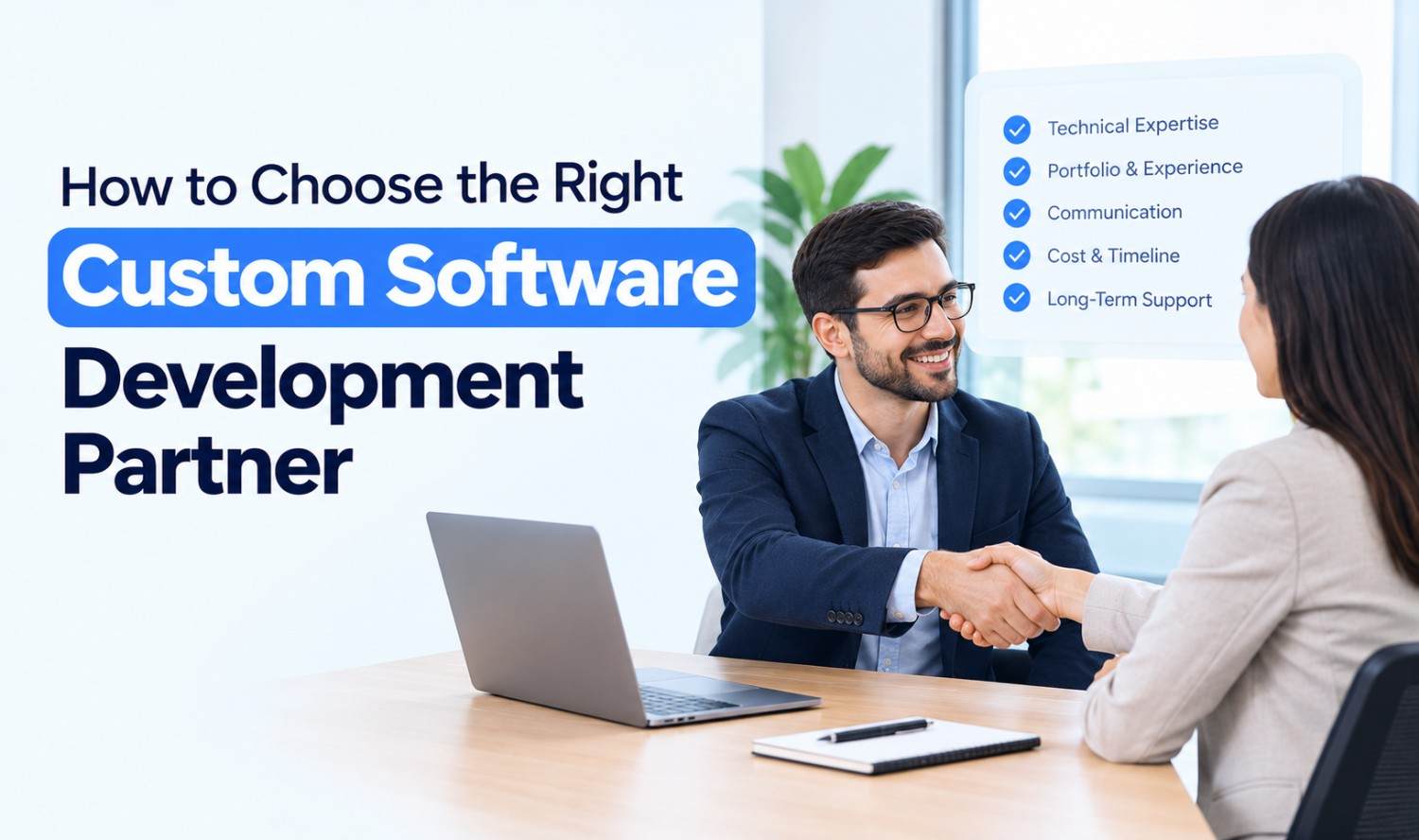

Knowing how to choose the right custom software development company comes down to fit, not price. The right partner understands your problem, shows relevant past work, follows sound engineering and security practices, communicates clearly, and gives you full ownership of the code in writing.
This guide walks you through what to look for in a software development company, step by step. You’ll get the questions to ask, the pricing models to compare, the red flags to avoid and a simple scorecard for comparing vendors side by side.
Key Takeaways
- Start with your goals: A clear scope makes every vendor easier to judge.
- Meet the real team: The people who pitch aren’t always the people who build.
- Own your code: Get a signed IP assignment, not just a “work for hire” line.
- Check security early: Ask about NIST SSDF and OWASP practices.
- Start small: A paid discovery phase lowers your risk before a full build.
Do You Need Custom Software?
You need custom software when off-the-shelf tools can’t support a core process, a key integration or a feature that sets your business apart. If a SaaS product or low-code platform covers most of your needs, start there. Custom builds cost more upfront, so they should solve a problem that matters.
Custom software usually makes sense when:
- Your process is unique: Your workflow is part of your competitive edge.
- Systems don’t connect: You need to link tools that have no ready integration.
- You’ve outgrown SaaS: Per-seat fees or feature limits keep rising.
- You have strict rules: Compliance, data location or security needs rule out shared platforms.
Off-the-shelf or low-code is usually better when the process is standard, such as payroll or basic CRM, or when you need something running within weeks.
How to Choose the Right Custom Software Development Company: 9 Steps
The steps below cover the full selection process, from defining your project to signing the contract. Work through them in order. Each step narrows your shortlist, so by the end you’ll be comparing two or three serious candidates instead of a dozen proposals that are hard to tell apart.
1. Define Your Goals, Scope and Budget
Write a one-page brief before you contact any vendor. Include the business problem, target users, must-have features, systems to integrate, deadline and budget range. A clear brief gets you comparable proposals and shows which firms actually read it.
2. Check Relevant Experience and Portfolio
Look for projects similar to yours in industry, size or technical complexity. Ask for live products or case studies, not just screenshots. A firm that has built a healthcare app or a logistics platform before will spot problems sooner.
3. Verify References and Reviews
Ask for at least two client references and call them. Ask what went wrong and how the vendor handled it. Independent review sites help, but a direct conversation with a past client tells you far more.
4. Meet the Team That Will Build It
Sales leads and senior architects often run the pitch, then hand the work to someone else. Ask who will be on your project, their roles and their experience. Confirm whether any work will be subcontracted.
5. Assess Engineering and QA Practices
Ask how they handle code review, automated testing, version control and deployment. A good team can explain its process in plain language and show how it catches bugs before release. Also ask how they document code so another team could take over later.
6. Check Security and Compliance
Ask whether the team follows the NIST Secure Software Development Framework (SP 800-218) and tests against the OWASP Top 10:2025 web security risks. If you handle health data, the vendor will generally need to sign a HIPAA business associate agreement. Ask the same about any other rules that apply to your industry.
7. Ask How They Use AI
Most development teams now use AI coding tools. Ask which tools they use, how AI-generated code is reviewed, and whether your code or data is ever shared with outside AI services. If you want AI features in your product, ask for examples they’ve shipped.
8. Review Communication and Project Management
Agree on how often you’ll meet, who your main contact is and which tools you’ll use to track progress. Regular demos of working software are better than status reports. Check how much their working hours overlap with yours.
9. Get IP Ownership and Exit Terms in Writing
Under US copyright law, the creator of a work usually owns it. Software built by an outside firm generally isn’t a “work made for hire,” according to the US Copyright Office. The Copyright Act also says a transfer of ownership must be in writing and signed, so your contract should include a clear IP assignment clause.
Also cover access to source code and repositories, third-party and open source licenses, and how the handover works if you part ways. This is general information, not legal advice, so have a lawyer review the contract.
Questions to Ask a Software Development Company
The right questions show how a vendor thinks, not just what it sells. Ask every shortlisted firm the same set, so you can compare answers fairly. Strong vendors answer clearly and ask you smart questions back. Vague or overly polished answers are a warning sign.
- Similar work: Which past project is closest to ours, and what did you learn from it?
- Team: Who exactly will work on our project, and will that change?
- Process: How do you handle changes to scope after work starts?
- Quality: What does your testing and code review process look like?
- Security: Which security practices and standards do you follow?
- AI use: How do you use AI tools, and how do you protect our code?
- Ownership: Will we own all code, designs and documentation?
- Support: What happens after launch, and what does it cost?
Pricing and Engagement Models
Most custom software firms offer three engagement models: fixed price, time and materials, and dedicated team. Fixed price suits small, well-defined projects. Time and materials suits projects where requirements will change. A dedicated team suits long-term products that need steady, ongoing development.
| Model | How It Works | Best For | Main Risk |
|---|---|---|---|
| Fixed price | One agreed price for a defined scope | Small projects with clear requirements | Change requests add cost and delay |
| Time and materials | You pay for hours actually worked | Projects that will evolve | Budget can grow without close tracking |
| Dedicated team | A team works only on your product, billed monthly | Long-term products | Higher ongoing commitment |
Ask vendors what drives their estimate. Cost depends on scope, integrations, design, compliance needs and team location. For context, the median US software developer salary was $135,980 in May 2025, according to the Bureau of Labor Statistics, which is useful when comparing outsourcing with hiring.
Onshore, Nearshore or Offshore?
Onshore means the team is in your country, nearshore means a nearby country with similar time zones, and offshore means a distant country. For US buyers, each option trades cost against time zone overlap and legal simplicity. The right choice depends on how closely you need to work together.
| Option | Time Zone Overlap | Typical Cost | Consider When |
|---|---|---|---|
| Onshore (US) | Full | Highest | You need close collaboration or strict compliance |
| Nearshore (e.g., Latin America) | High | Medium | You want daily calls at lower cost |
| Offshore (e.g., Asia, Eastern Europe) | Low | Lowest | Work is well defined and async-friendly |
Many firms mix models, with a US-based lead and a distributed development team.
Red Flags to Watch For
When choosing a software development company, the biggest red flags are vague answers, pressure to sign quickly and unclear ownership terms. A low price with no detailed plan is another warning sign. If a vendor won’t let you meet the team or talk to past clients, keep looking.
- Instant quotes: A firm price before they understand your needs.
- No discovery: They skip questions and jump to a proposal.
- Hidden team: You can’t meet the developers.
- Unclear IP: The contract doesn’t assign code ownership to you.
- No references: They can’t connect you with past clients.
- “Yes” to everything: No pushback on scope, timeline or budget.
How to Compare Vendors With a Scorecard
A vendor scorecard turns your shortlist into a fair, side-by-side comparison. Rate each firm from 1 to 5 on the criteria that matter most, weight each criterion by importance, and add up the scores. This keeps the decision objective and stops one polished pitch from outweighing real evidence.
Here’s an illustrative example with three made-up vendors. Each score is multiplied by its weight, then added up.
| Criterion | Weight | Vendor A | Vendor B | Vendor C |
|---|---|---|---|---|
| Relevant experience | 20% | 5 | 3 | 4 |
| Team quality | 20% | 4 | 4 | 3 |
| Engineering and security | 20% | 4 | 5 | 3 |
| Communication | 15% | 3 | 5 | 4 |
| Price and model fit | 15% | 3 | 4 | 5 |
| Contract and IP terms | 10% | 4 | 5 | 2 |
| Weighted total | 100% | 3.90 | 4.25 | 3.55 |
In this example, Vendor B comes out ahead even though Vendor A has more experience and Vendor C is cheapest. Adjust the weights to fit your project. A healthcare app, for example, might give security a larger share.
Start Small With a Discovery Phase
The safest way to choose a custom software development partner is to start with a small, paid discovery phase or prototype. In a few weeks, you’ll see how the team works, how it communicates and how it handles feedback, before you commit to a full build.
A discovery phase typically produces a clear scope, a technical plan and a clickable prototype. Our guide to rapid prototyping explains how this works. If the first phase goes well, you can move into full development with much less risk.
Frequently Asked Questions
How do I choose a custom software development company?
Define your goals and budget, then compare firms on relevant experience, team quality, engineering and security practices, communication and contract terms. Call references, meet the team and start with a small paid phase.
How long does custom software development take?
It depends on scope. A simple prototype may take a few weeks, while a complex platform can take many months. Ask each vendor for a phased timeline based on your brief.
How much does custom software cost?
Cost depends on scope, integrations, design, compliance needs and team location. Ask vendors to break down their estimates so you can compare them fairly.
Should I choose fixed price or time and materials?
Choose fixed price for small projects with clear, stable requirements. Choose time and materials when requirements are likely to change and you want flexibility.
Who owns the code in a custom software project?
Under US law, the creator usually owns the copyright unless it’s transferred in a signed written agreement. Make sure your contract assigns all code and IP to you, and have a lawyer review it.
Is a development agency better than a freelancer?
An agency offers a full team, project management and backup if someone leaves. A freelancer can cost less and suits smaller, well-defined tasks.
What happens after the software launches?
Most projects need ongoing maintenance, security updates and new features. Agree on a support plan, response times and costs before you sign.