
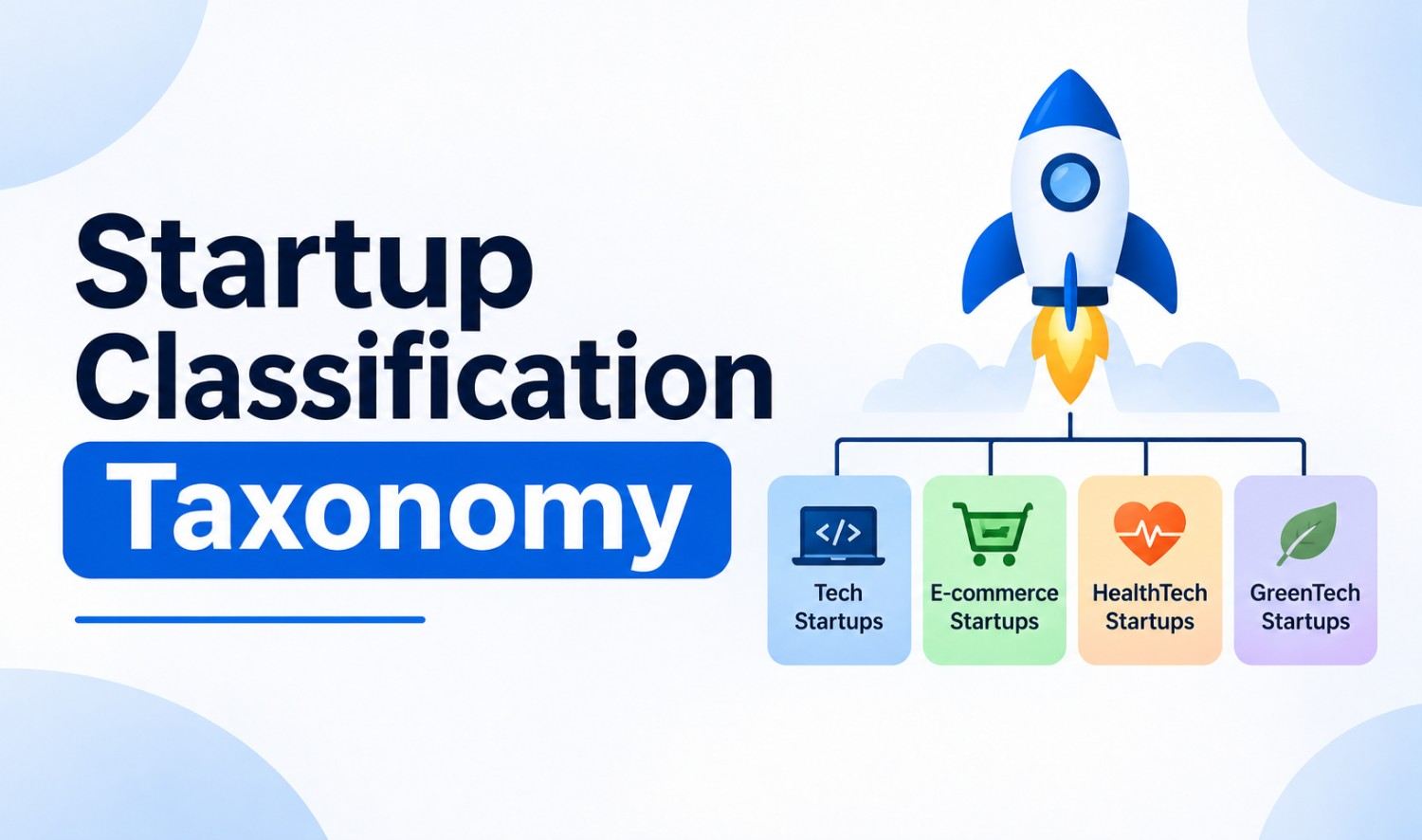

A startup classification taxonomy is a structured set of categories used to sort startups by industry, technology, business model and stage. Good startup classification taxonomy guidelines and category mapping rules make sure every company lands in the right bucket, the same way, every time, whether a person or an AI does the tagging.
Without shared rules, one analyst files a company under “AI,” another under “SaaS” and a third under “Health Care.” Investors, accelerators, research teams and sales teams all need consistent categories to compare companies, spot trends and build reliable lists. This guide shows you the main classification systems, the rules for mapping startups to categories and how to map job titles like Founder or CEO to business functions.
What Is a Startup Classification Taxonomy?
A startup classification taxonomy is a hierarchy of categories, such as sector, industry and sub-industry, used to organize startups consistently. It includes the category list itself, a definition for each category and the rules for assigning companies. Investors, data platforms and ecosystem builders use these taxonomies to compare companies and track markets.
Most startup taxonomies combine several dimensions:
- Industry: What market the startup serves, such as health care or fintech.
- Technology: What it’s built on, such as AI, blockchain or robotics.
- Business model: How it sells, such as B2B SaaS, marketplace or D2C.
- Stage: How far along it is, such as pre-seed, seed or Series A.
- Impact: Optional tags like climate or the UN Sustainable Development Goals.
Dealroom, for example, defines a startup as “a company designed to grow fast” and classifies companies against “a comprehensive taxonomy of industries and sub-industries,” plus technologies and the UN’s 17 Sustainable Development Goals.
Common Startup Classification Systems
The most common startup classification systems are NAICS and SIC for official industry codes, GICS for public market sectors and Crunchbase and Dealroom for startup and venture data. Official codes are stable and standardized, while startup platforms are more detailed and better at capturing new sectors like AI or climate tech.
| System | Maintained By | Structure | Best For |
|---|---|---|---|
| NAICS | US, Canada and Mexico statistical agencies | Six-digit codes across 20 sectors | Government data, compliance, official reporting |
| SIC | Legacy US system (succeeded by NAICS) | Four-digit codes, Divisions A to J | Older databases and some filings |
| GICS | MSCI and S&P Dow Jones Indices | Four tiers, 11 sectors | Public companies and investment analysis |
| Crunchbase | Crunchbase | 700+ industries in 40+ industry groups | Startup research and sales prospecting |
| Dealroom | Dealroom | Industries, sub-industries, technologies and SDGs | Venture and ecosystem analysis |
According to the Bureau of Labor Statistics, NAICS uses “a production-oriented conceptual framework” and a “six-digit hierarchical coding system.” That makes it reliable, but it can lag behind fast-moving startup categories.
One note: the EU Taxonomy is often mentioned in startup searches, but it classifies sustainable economic activities for finance and disclosure purposes. It isn’t a general system for sorting startups by sector.
Guidelines for Building a Startup Taxonomy
To build a startup taxonomy, start with a clear purpose, choose a base system, keep the hierarchy shallow, write a definition for every category and set rules for updates. Good guidelines make the taxonomy easy to apply, easy to explain and stable enough to compare data over time.
- Define the purpose: Investment research, sales targeting and ecosystem reports each need different levels of detail.
- Start from a standard: Build on NAICS, GICS or a platform taxonomy instead of inventing everything from scratch.
- Keep it to three levels: For example, sector, industry and sub-industry. Deeper trees get hard to apply.
- Write definitions: Each category gets a one-sentence definition, two or three examples and a list of what doesn’t belong.
- Use preferred and alternative labels: The W3C SKOS standard separates a preferred label (prefLabel) from alternative labels (altLabel), so “Fintech” and “Financial Technology” point to the same category.
- Include an “Other” category: Use it sparingly, and review it often for new categories.
- Version your taxonomy: Log every added, renamed or merged category with a date.
- Assign an owner: One person or team approves changes.
Category Mapping Rules
Category mapping rules tell you exactly how to assign each startup to a category and how to translate between classification systems. The core rules are one primary category per startup, a few secondary tags, classification by core revenue activity and documented crosswalks between schemes like Crunchbase industries and NAICS codes.
Here are 10 rules that keep mapping consistent:
- One primary category: Assign each startup exactly one primary industry.
- A few secondary tags: Add secondary industries or technologies. Crunchbase, for example, lets profiles belong to multiple industries and recommends three to five.
- Classify by core revenue activity: Use what the company sells, not what it uses. An AI tool for hospitals is primarily health care, with AI as a technology tag.
- Most specific level wins: Choose the deepest category that clearly fits.
- Tie-break by revenue share: If two industries fit, pick the one that drives more revenue.
- Map, don’t merge: When translating between systems, record matches as exact or close. SKOS provides exactMatch and closeMatch properties for this.
- Keep a crosswalk table: Document how each internal category maps to NAICS, GICS or platform categories. Crunchbase also exposes NAICS codes in its API, which helps.
- Use “Other” with a note: Explain why nothing fits, so you can create new categories later.
- Reclassify on pivots: When a startup changes its business model, update the category and log the date.
- Record the source and confidence: Note whether a person or AI assigned the category and how confident it was.
How to Map Job Titles to Business Functions
To map job titles to business functions, classify each title by what the person actually does, not by the exact wording of the title. Founders, CEOs and managing directors usually map to Executive Leadership. Board members and advisors map to Governance or Advisory. Functional leaders map to their department, such as Marketing or Product.
For an official reference, the Bureau of Labor Statistics’ 2018 Standard Occupational Classification places every occupation in one of 23 major groups. Chief Executives (11-1011) sit under Management Occupations and “determine and formulate policies and provide overall direction” of organizations.
The table below shows our recommended mappings for common startup titles. These are practical guidelines, not an official standard, so adjust them to fit your taxonomy.
| Job Title | Recommended Function Category | Notes |
|---|---|---|
| Founder, Co-Founder | Executive Leadership | Use their operating role if listed (for example, “Founder and CTO” maps to Engineering leadership too) |
| CEO, Managing Director | Executive Leadership | Matches SOC Chief Executives (11-1011) |
| Amministratore Delegato | Executive Leadership | Italian title roughly equal to managing director or CEO |
| CIO, CTO | Executive Leadership, plus IT or Engineering | Dual-tag by function |
| Board Member, Chair | Governance (Board) | Not an operating role |
| Operating Advisor, Advisor | Advisory | Separate from employees and board |
| Partner (VC or law firm) | Executive Leadership or Investment | Depends on the firm type |
| Business Director | Business Operations or General Management | Check the department in the profile |
| Design Director | Product and Design | Not Marketing, unless it’s a brand design role |
| Head of Marketing | Marketing | Functional leader |
| Staff Software Engineer | Engineering | Senior individual contributor, not management |
| Business Owner | Executive Leadership | Avoid filing it under “Other” |
Tie-break rules for titles:
- Combined titles: For “Founder and CEO,” use the most senior operating role.
- Function beats seniority: “Head of Marketing” is Marketing first and leadership second.
- Unclear titles: Check the department, LinkedIn summary or company page before using “Other.”
Using AI to Classify Startups and Job Titles
AI models can classify thousands of startups and job titles in minutes, but they need clear rules to stay consistent. Give the model your category list, definitions, mapping rules and examples, ask it to return a category with a confidence score and send low-confidence results to a person for review.
A simple workflow looks like this:
- Prepare inputs: Company description, website text or job title and department.
- Provide the taxonomy: Include category names, definitions and examples in the prompt.
- Set the output format: Primary category, secondary tags, confidence score and a short reason.
- Route by confidence: Auto-accept high-confidence results, and send the rest to human review.
- Audit samples: Check a random sample each week, and update rules when errors repeat.
If you’d like to automate this at scale, our AI agent development team builds classification agents that follow your taxonomy and review rules.
Worked Example: Classifying Three Startups
Here’s an illustrative example of how the rules work in practice. Each startup gets one primary category based on what it sells, plus secondary tags for technology and business model. The examples are invented for illustration and don’t describe real companies.
| Startup (Illustrative) | What It Sells | Primary Category | Secondary Tags |
|---|---|---|---|
| ClinicFlow | AI scheduling software for clinics | Health Care | AI, B2B SaaS |
| GreenFleet | EV charging management for delivery fleets | Energy and Climate | IoT, B2B SaaS |
| PayNest | Payment app for freelancers | Fintech | Mobile, B2C |
Notice that ClinicFlow is Health Care, not AI. AI is how it works, but health care is the market it serves. That’s rule 3 in action.
Common Classification Mistakes
The most common startup classification mistakes are using technology as the primary category, creating too many overlapping categories, skipping definitions and letting the taxonomy go stale. These errors make data inconsistent and hard to compare. Clear rules, regular reviews and a single owner prevent most of them.
- Tech-first labels: Calling every AI company “AI” hides the market it actually serves.
- Overlapping categories: “E-commerce” and “Online Retail” as separate buckets confuse taggers.
- Too many levels: Deep hierarchies make consistent tagging nearly impossible.
- No definitions: Without them, two people will classify the same startup differently.
For a related approach inside software systems, see our guide on how to classify software application components.
Frequently Asked Questions
What is a startup classification taxonomy?
A startup classification taxonomy is a structured list of categories, such as sector, industry and sub-industry, used to organize startups consistently. It includes category definitions and rules for assigning companies.
Which category is a founder in a business function taxonomy?
A founder usually belongs in Executive Leadership. If the founder also holds an operating role, like CTO or Head of Product, add that function as a secondary tag.
How do you classify a CEO in a taxonomy?
Classify a CEO under Executive Leadership. In the US Standard Occupational Classification, Chief Executives are code 11-1011 under Management Occupations.
Where does a design director fit in a business function taxonomy?
A design director usually fits under Product and Design. If the role focuses on brand or campaigns, Marketing may be a better fit.
What category is an operating advisor?
An operating advisor is usually classified as Advisory, separate from employees and board members, because advisors guide the business without holding an operating role.
What is the best classification system for startups?
It depends on your goal. NAICS suits official reporting, GICS suits public market analysis, and Crunchbase or Dealroom suit startup and venture research because they track newer categories.
What are category mapping rules?
Category mapping rules are the instructions for assigning companies or titles to categories and translating between systems. Key rules include one primary category, a few secondary tags and documented crosswalks.