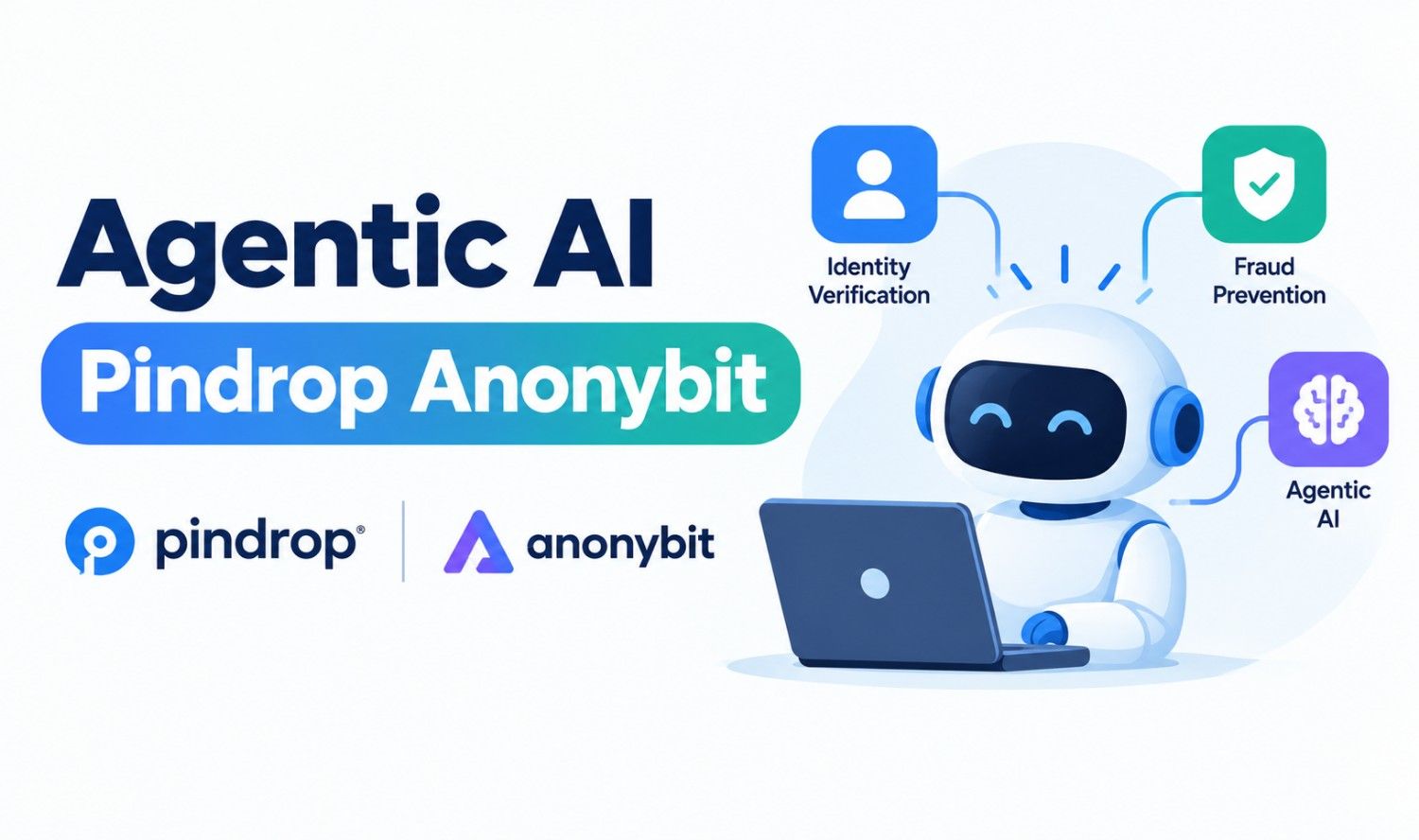

Agentic AI Pindrop Anonybit is a shorthand for a layered defense against voice deepfakes: Pindrop checks whether a voice is real, Anonybit verifies identity without a central biometric database, and an agentic AI layer decides what to do next. It’s a concept, not a single product you can buy.
That last point matters, because a lot of articles make it sound like the two companies built something together. They didn’t. Pindrop and Anonybit are separate companies, and neither one mentions the other on its website. What they do share is a problem: AI can now copy a voice well enough to fool people and older security checks. Here’s how each piece works, how they fit together and where Pindrop’s own “agentic AI” work fits in.
What Is Agentic AI Pindrop Anonybit?
The phrase describes three technologies working as one decision system for identity and fraud. Pindrop handles voice and call risk, Anonybit handles privacy-safe biometric verification, and agentic AI acts on the results in real time. The term came from industry blogs, not from either company, so treat it as an architecture idea.
Here’s the simple version:
- Pindrop: Is this voice real, and does this call look risky?
- Anonybit: Is this person who they claim to be, verified without exposing their biometrics?
- Agentic AI: Given both answers, what should happen right now?
You could swap any layer for another vendor and keep the same design. That’s why it’s more useful to understand the roles than the brand names.
Why Voice Deepfakes Broke Traditional Security
Older phone security relied on things a fraudster can now fake or buy: a familiar voice, knowledge-based questions and caller ID. AI voice cloning turned those checks into weak points, and fraud numbers rose sharply as a result. Businesses needed checks that look past what a caller says.
The early warning came in 2019, when an executive at a UK energy firm wired $243,000 after a scammer used AI to mimic his boss’s voice, as reported by The Wall Street Journal. Since then, the problem has grown fast:
- Deepfake attempts: Pindrop’s 2025 Voice Intelligence and Security Report says deepfake fraud attempts rose more than 1,300% in 2024, from about one a month to seven a day.
- Industry spikes: The same report found synthetic voice attacks rose 475% at insurers and 149% at banks in 2024.
- Consumer losses: The FTC says Americans reported losing about $16 billion to fraud in 2025, the highest on record, including $3.5 billion to imposter scams.
What Pindrop Does
Pindrop is a voice security company that detects deepfakes, scores fraud risk on live calls and authenticates known callers. It analyzes the audio, device and behavior behind a call, not just the words, so a cloned voice reading the right answers can still get flagged.
Its main products, according to Pindrop:
- Pulse for Contact Centers: Identifies synthetic speech in phone calls.
- Pulse for Meetings: Detects deepfakes in online meetings.
- BotStopper: Detects AI-driven traffic hitting a contact center.
- Protect: Assesses fraud risk during live interactions.
- Passport: Authenticates known callers with less friction.
- Fraud Assist: An add-on that brings AI-assisted investigation workflows to fraud teams.
Pindrop says it uses more than 2,300 detection signals, holds over 300 patents and serves 14 of the top 20 banks. The FTC also gave it a Recognition Award in its 2024 Voice Cloning Challenge.
What Anonybit Does
Anonybit protects biometric data by never storing it in one place. It breaks identity data into anonymized pieces, spreads them across a network of nodes and uses multi-party computation to verify a person. If attackers breach one location, they don’t get a usable fingerprint, face or voiceprint.
That solves a problem every biometric system has: you can reset a password, but you can’t reset your face. In Anonybit’s own words, “centralized honeypots are impossible to protect.”
What to know:
- Decentralized storage: No single database holds complete biometric records.
- Multi-party computation: Verification happens across the network without exposing the full data.
- Agent identity: In 2025, Anonybit said its platform can bind AI agents to verified human identities, limit them to scoped tasks and keep an audit trail.
- Vendor claims: Anonybit reports over 99% authentication accuracy and 85% less time to authenticate than traditional methods.
What Agentic AI Adds to Fraud Prevention
Agentic AI is software that can make decisions and take actions toward a goal, not just answer questions. In fraud prevention, it reads signals from tools like Pindrop and Anonybit, weighs the context and acts in seconds, which is faster than a human analyst reviewing every call.
In this setup, the agent can:
- Combine signals: Merge voice risk, identity results, account history and the request type.
- Pick an action: Allow the call, ask for step-up verification, limit the transaction or route to a human.
- Adapt mid-call: Change course if risk rises halfway through a conversation.
- Document decisions: Log why it acted, so teams can audit and improve it.
If you’re new to the idea, our guide to AI agents vs chatbots explains what makes an agent different.
How the Three Layers Work Together
The layers run in sequence on every sensitive interaction: Pindrop checks the voice and call, Anonybit confirms identity, and the agent turns both results into a decision. Low-risk callers move through quickly, while suspicious ones face extra checks or a human review.
A typical call flow:
- Call arrives: A customer calls the bank to change a payout account.
- Voice check: Pindrop analyzes the audio and call signals for synthetic speech and fraud risk.
- Identity check: Anonybit verifies the caller’s biometrics against distributed data, with no central template exposed.
- Decision: The agent weighs both results with the request’s risk. A high-value change plus a risky voice signal triggers step-up verification.
- Action and log: The agent approves, challenges or escalates, then records its reasoning.
No layer is perfect alone. Together, they make an attacker beat voice detection, biometric verification and contextual judgment at the same time.
Building Trust With Agentic AI From Pindrop
Pindrop has its own view of agentic AI, published in June 2026 in its article “Building Trust in the Age of AI.” It sees AI agents as a new trust problem: some will help customers, and others will impersonate people or commit fraud across voice, video and other channels.
Pindrop describes a two-sided approach:
- Defend against outside agents: Detect third-party AI agents that impersonate people or attempt fraud.
- Use agents internally: Fraud Assist already helps analysts review calls and speed up investigations, and Pindrop says it’s expanding into security agents that spot patterns across large volumes of interactions.
- A simple trust test: Pindrop’s chief product officer frames trust around three questions: Is it the right entity? Is the intent right? Is the action right?
That three-question test is a useful checklist for any business deploying AI agents, whether you use Pindrop or not.
Where This Approach Helps Most
The layered model fits organizations that handle high-value requests over the phone or video, where one fake voice can move money or expose personal data. Banks, insurers, healthcare providers and large contact centers face the most pressure today, because their calls often move money or open private records.
- Banking: Protects account changes, wire requests and password resets.
- Insurance: Pindrop’s data shows insurers saw the sharpest rise in synthetic voice attacks.
- Healthcare: Protects patient accounts and benefits information during calls.
- Contact centers: Screens high call volumes without slowing down genuine customers.
- Remote hiring and meetings: Pulse for Meetings helps spot deepfaked participants.
Limits to Keep in Mind
No layered system stops every attack, and this one comes with real costs and trade-offs. Detection tools can produce false positives, enterprise products carry enterprise pricing, and an AI agent is only as good as the rules and oversight around it.
- No official bundle: You’ll integrate separate vendors yourself or through a partner.
- Cost: Pindrop and Anonybit don’t publish standard pricing, so expect custom quotes.
- False positives: Overly strict settings can frustrate real customers.
- Oversight: Agents need clear limits, human review for high-risk actions and regular tuning.
- Evolving attacks: Deepfake tools keep improving, so detection must keep updating.
Securing Your Own AI Voice Agents
If your business uses AI voice agents or chatbots, the same trust rules apply to them. Your agents should verify who they’re talking to, stay within approved actions and log every decision, so attackers can’t use them as an easy way in.
Practical steps:
- Verify first: Add voice or identity checks before an agent handles sensitive requests.
- Scope actions: Limit what the agent can do without a human, such as payments or account changes.
- Watch for bots: Flag AI-driven callers that test your systems at scale.
- Keep audit logs: Record what the agent did and why.
- Escalate smartly: Hand risky conversations to trained staff.
Frequently Asked Questions
Is Agentic AI Pindrop Anonybit a real product?
No. It’s a term for combining three technologies: Pindrop’s voice fraud detection, Anonybit’s decentralized biometrics and an agentic AI decision layer. Pindrop and Anonybit are separate companies with no announced partnership or joint product.
What does Pindrop do?
Pindrop detects voice deepfakes, scores fraud risk on live calls and authenticates known callers. Its products include Pulse, Protect, Passport, BotStopper and the Fraud Assist add-on for fraud investigations.
How is Anonybit different from a normal biometric database?
A normal system stores biometric templates in one central database. Anonybit splits identity data into anonymized pieces across a network and verifies people with multi-party computation, so there’s no single honeypot to steal.
What does building trust with agentic AI from Pindrop mean?
It refers to Pindrop’s June 2026 approach to AI agents. Pindrop defends against fraudulent outside agents, uses agents internally for investigations and judges trust by asking whether the entity, intent and action are right.
Can this approach stop deepfakes in video calls?
It can help. Pindrop offers Pulse for Meetings to detect deepfakes in online meetings, and an agentic layer can act on those alerts. No tool catches every deepfake, so human review still matters.
Who needs this kind of defense?
Organizations that handle high-value requests by phone or video, such as banks, insurers, healthcare providers and large contact centers. Smaller businesses using AI voice agents can apply the same principles at a smaller scale.