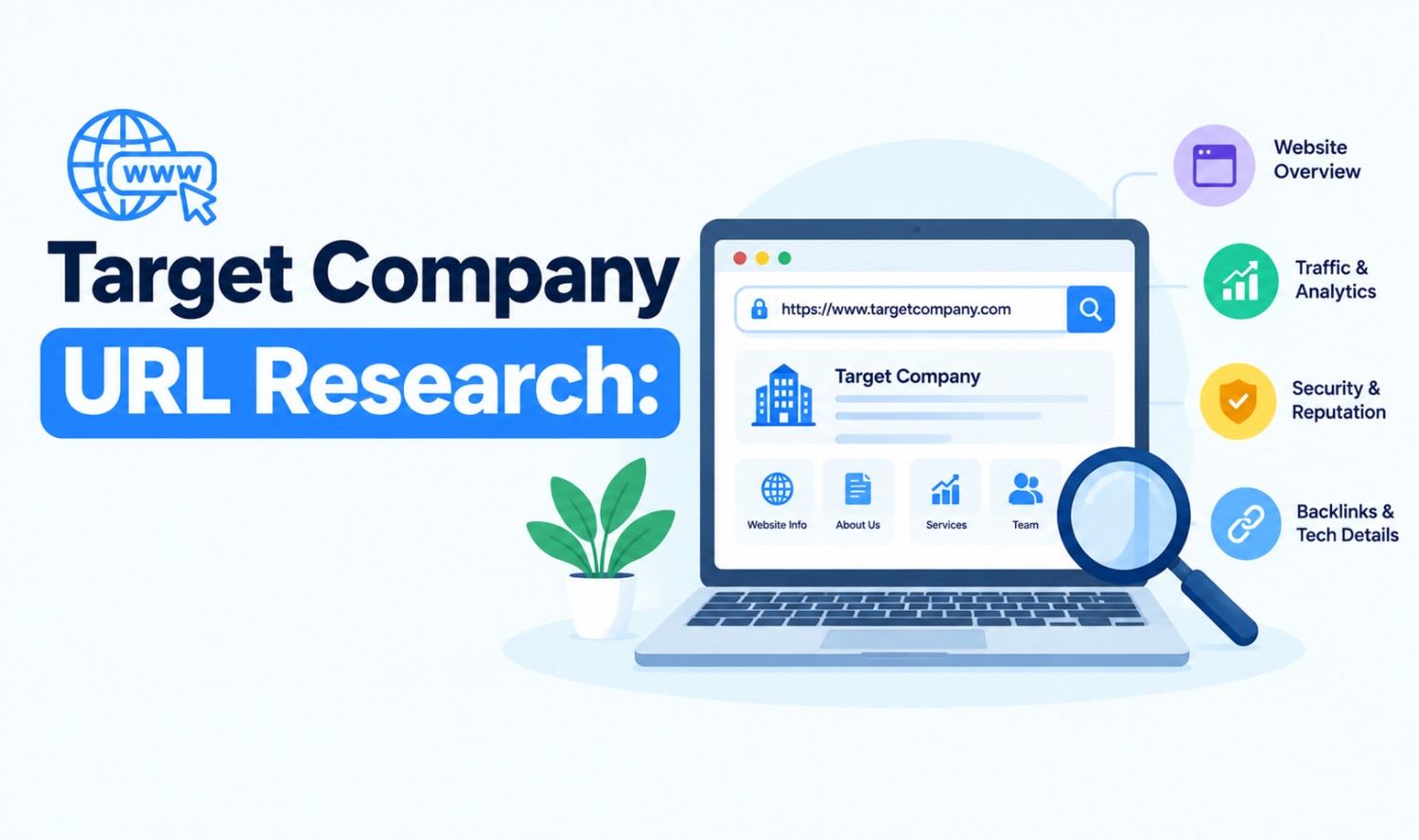

Target company URL research is the process of finding a company’s official website, confirming it belongs to the right business, and then studying the site to learn about the company. It’s used in sales, recruiting, partnerships, investing and competitor research. The term is a general business research phrase and has no connection to the retailer Target Corporation.
This guide covers how to find the real website, verify it, spot fakes and analyze it.
What Is Target Company URL Research?
Target company URL research means identifying the correct web address for a business you’re researching and confirming that it’s official. A “target company” can be any business: a prospect, employer, supplier, competitor, partner or acquisition target. The goal is a verified URL you can trust, not just the first search result.
It usually covers more than one address. Many companies run several domains, such as:
- Main website: The primary company site, often a .com domain.
- Regional sites: Country versions like a .co.uk or .de domain.
- Product or brand sites: Separate domains for individual products.
- Supporting sites: Careers portals, help centers, investor pages and customer logins, sometimes hosted on third-party platforms.
Why the Right URL Matters
The right URL matters because everything you research next depends on it. A wrong domain leads to wrong company details, emails sent to the wrong business and records in your CRM that don’t match reality. It can also lead you to an impersonation site built to look like the real company.
The risk isn’t small. The FTC reports that impersonation scams cost nearly $3 billion in reported losses during 2024. The FTC’s Government and Business Impersonation Rule took effect on April 1, 2024, giving the agency stronger tools against these scams.
Common reasons people do target company URL research:
- B2B sales: Finding the right domain before building prospect lists or email outreach.
- Recruiting: Confirming an employer’s real careers page before applying.
- Vendor checks: Making sure a supplier or partner is a real, active business.
- Market research: Mapping competitors and their brands.
How to Find a Company’s Official Website
To find a company’s official website, search its exact legal name, compare the results against other trusted sources, and confirm the site clearly identifies the business. Start with the most specific details you have, such as location or industry, so you don’t confuse companies with similar names.
A simple manual process:
- Search the exact name: Put the full company name in quotes and add the city, state or industry.
- Check the official profiles: Look at the company’s verified social media pages, which usually link to its main site.
- Check public records: For US public companies, SEC EDGAR filings list the official company name and business address.
- Compare details: Confirm the address, phone number and leadership on the site match what other sources show.
- Note other domains: Record regional, product and careers domains separately from the main one.
How to Verify a Target Company URL
To verify a target company URL, confirm three things: the site clearly identifies the business, independent records match its details, and the domain’s registration data is consistent. A domain that passes all three checks is very likely official. One that fails any of them needs more research before you rely on it.
| Check | What to Look For | Where to Check |
|---|---|---|
| Company identity | Legal name, address and contact details on the site | The website’s About, Contact and legal pages |
| Business registration | The company is registered and active in its state | State business registry (Secretary of State) |
| Domain registration | Current registration data for the domain | ICANN Lookup |
| Site history | How long the site has existed and past versions | Wayback Machine |
| Official profiles | Social and professional profiles that link to the same domain | The company’s verified social accounts |
| Public filings | Name and address match SEC records, for public companies | SEC EDGAR |
The SBA notes that most states require businesses to register with the Secretary of State’s office or a similar agency, so a state registry check is a reliable first step for US companies.
Keep in mind that HTTPS only means the connection is encrypted. It doesn’t prove who owns the site.
How to Spot a Fake or Look-Alike Domain
You can spot a fake domain by comparing it carefully with the verified one and looking for small differences in spelling, extra words or unusual extensions. Scammers often build sites that copy a real company’s look. The FTC has flagged sites designed to look similar to official tools, like the IRS’s free EIN service.
Warning signs:
- Misspellings: A swapped letter or added character, such as “companny” instead of “company.”
- Extra words: Additions like “-support,” “-login” or “-official” in the domain.
- Odd extensions: A different ending from the company’s usual domain.
- Missing details: No legal name, address or real contact information.
- Very new sites: A site with no history, even though the company claims to be well established.
The FTC’s advice for suspicious messages applies here too: “contact the company using a phone number or website you know is real.” Its guide to phishing scams covers more warning signs.
Target Company Website Analysis: What to Research From the URL
Target company website analysis means studying a verified site to learn how the business works, what it sells and where it’s heading. Target company research via URL can reveal products, pricing, customers, leadership, hiring plans and messaging. Record the date you checked each page, since websites change often.
What to review on the site:
- Products and services: What the company sells and who it serves.
- Pricing: Published plans or price ranges, if any.
- Customers: Case studies, logos and testimonials.
- Leadership: The team page and executive bios.
- Careers page: Open roles often show growth areas and the tools the company uses.
- Legal pages: The privacy policy and terms often show the company’s legal name.
Target Company Value Proposition Research
Value proposition research looks at how the company describes the problem it solves and why customers should choose it. Read the homepage headline, product pages and calls to action. Note the main promise, the audience it targets and the proof it offers, such as customer results or reviews.
Checking Site History
The Wayback Machine shows earlier versions of a website. The Internet Archive passed one trillion archived web pages in October 2025. Older snapshots can reveal rebrands, past products, price changes and how long the business has really been online.
Researching Many Companies at Once
To research many company URLs at once, use a bulk lookup tool to generate candidate domains, then verify the results before using them. Bulk tools save time on long lists, but they work from name matching, so similar names, subsidiaries and rebrands can produce wrong results.
Most bulk tools return a match or confidence score. Treat it as a guide, not proof. A high score means the name matched well, not that the domain is confirmed.
One example is the free tool at targetcompanyurlresearches.com. According to its own pages, it:
- Input: Accepts up to 25 company names per run.
- Scores: Gives High, Medium or Low confidence for each match.
- Export: Lets you download results as a CSV file.
- Data source: Uses Clearbit Autocomplete.
That last point matters. Clearbit says its free tools were sunset on April 30, 2025, and lists Autocomplete in an “Unsupported APIs” section, noting that free products are provided “as-is.” Results from tools built on it can break or go out of date without warning.
For regular, large lists, teams often connect a lookup step to their CRM so new records get checked automatically. Our workflow automation services help US businesses build automations like this, with a human review step for uncertain matches.
Using AI for URL Research
AI tools can suggest company websites, summarize what a site says and speed up research on long lists. However, they can still give wrong answers. OpenAI, for example, warns that its deep research tool “can sometimes hallucinate facts.” Use AI for first drafts, then verify every URL yourself.
Good ways to use AI:
- Summaries: Condense a company’s website into key points.
- Comparisons: Compare value propositions across several competitors.
Common Mistakes to Avoid
The most common mistakes in target company URL research are trusting the first search result, ignoring subsidiaries and rebrands, and treating match scores as proof. Each one can send your research in the wrong direction. A short verification step at the start prevents most of them.
- Trusting the first result: Ads and look-alike sites can rank above the real one.
- Mixing up similar names: Two companies with nearly the same name can be unrelated.
- Ignoring parent companies: A brand’s site may belong to a larger parent company.
- Missing rebrands: Old domains may redirect or belong to someone else now.
- Skipping dates: Record when you verified each URL, and recheck it before important use.
Frequently Asked Questions
What is target company URL research?
It’s the process of finding a company’s official website, confirming it belongs to the right business, and analyzing the site to learn about the company. It’s used in sales, recruiting, vendor checks and market research.
Is target company URL research related to Target Corporation?
No. “Target company” means any business you’re researching. The phrase has no connection to the retailer Target Corporation.
How do I find a company’s official website?
Search the exact company name with its location or industry, check its verified social profiles, and compare the site’s details with public records such as state business registries or SEC filings.
How can I verify that a company website is real?
Confirm the site shows the company’s legal name and contact details, check that the business is registered in its state, review the domain’s registration data with ICANN Lookup, and check the site’s history in the Wayback Machine.
Does HTTPS mean a website is legitimate?
No. HTTPS means the connection to the site is encrypted. It doesn’t prove who owns the site, so you still need to verify the company behind it.
Are bulk company URL lookup tools accurate?
They’re useful for long lists, but they rely on name matching and can return wrong domains. Treat their match scores as a starting point and verify important results by hand.
Can AI find a company’s website?
AI can suggest likely websites and summarize them, but it can make mistakes. Verify any AI-suggested URL against official records before using it.