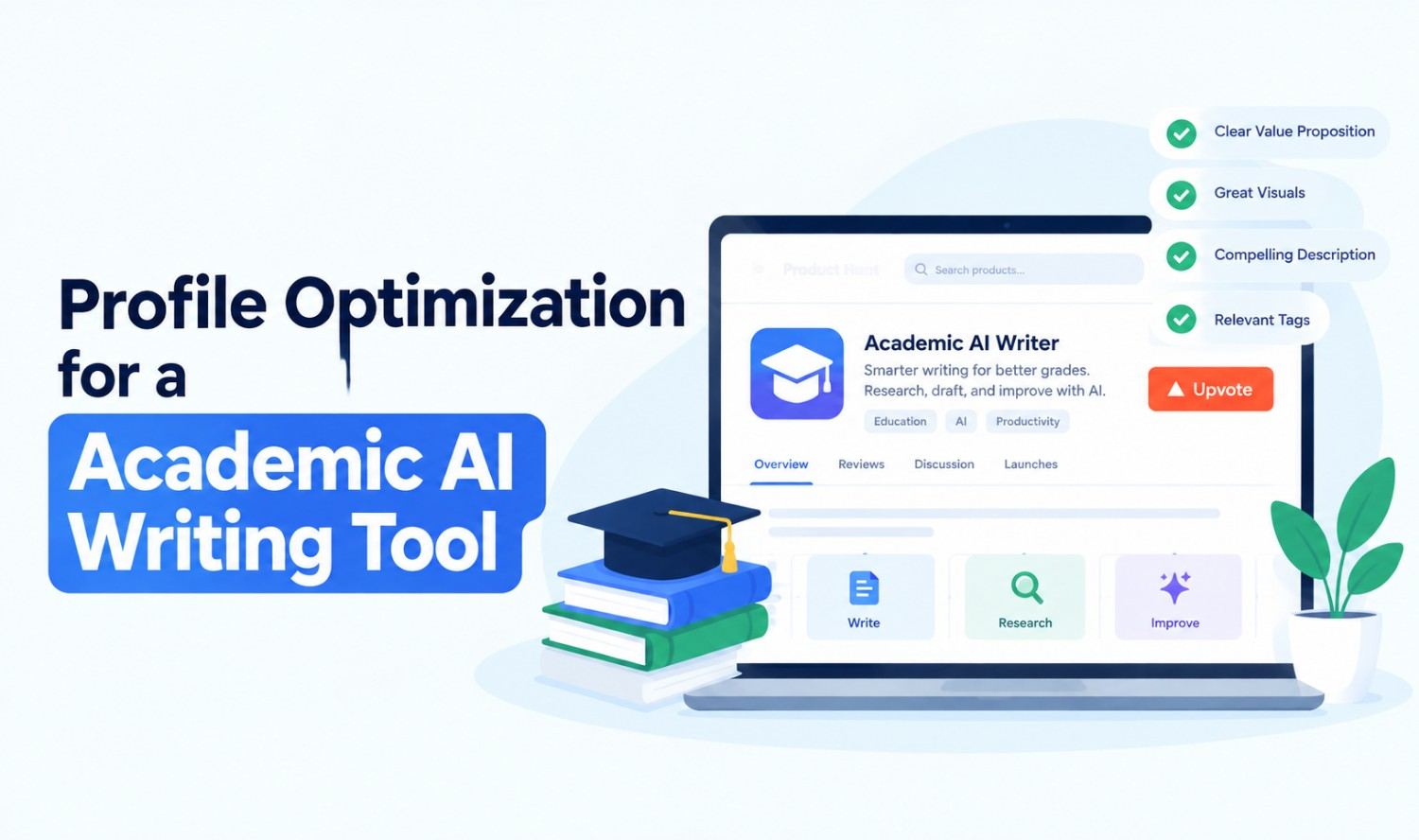

A value proposition for an academic AI writing tool is one clear sentence that says who the tool helps, what research or writing problem it solves, and why it’s better than general AI writing apps. On Product Hunt, that sentence shapes your tagline, description, gallery and first comment, so it decides how visitors understand your product.
This guide covers product hunt profile optimization for an academic AI writing tool value proposition from start to finish: a formula, Product Hunt’s official field limits, a worked example, the claims you can safely make and a pre-launch checklist.
Key Takeaways
- Start with one sentence: Name the user, the problem, the outcome and what makes you different.
- Follow official limits: Product Hunt caps taglines at 60 characters and asks for plain descriptions, not slogans.
- Use the first comment: About 70% of Product of the Day, Week or Month winners had a maker’s first comment.
- Back up every claim: The FTC says there’s “no AI exemption” from advertising laws.
- Position for integrity: Show how your tool supports research, not shortcuts.
What Is a Value Proposition for an Academic AI Writing Tool?
A value proposition is the specific reason a student, researcher or academic team should choose your tool over others. For an academic AI writing tool, it usually centers on research tasks like literature reviews, citations, structure and editing. A strong one is specific enough that a visitor understands it without reading further.
Academic users care about things general AI writing apps often miss:
- Citation accuracy: Sources that exist and match the claims they support.
- Source grounding: Output tied to papers the user provides or selects.
- Formatting: Support for citation styles and journal or university requirements.
- Integrity: Features that help users write their own work, not replace it.
Your value proposition should lead with whichever of these your tool does best.
How a Product Hunt Profile Works
A Product Hunt launch page has a few core parts: the product name, tagline, description, thumbnail, gallery, optional video, topics, makers and the first comment. Each one has official guidance, and together they carry your value proposition. Knowing the limits before you write saves rework on launch day.
| Field | Official Guidance |
|---|---|
| Name | The product’s name only, with no descriptions, emojis or “- tagline” after it |
| Tagline | Max 60 characters; a short, plain description, with no catchphrases or slogans |
| Description | Aim for 260 characters or fewer (Product Hunt’s pages list 260 and 500) |
| Thumbnail | Square, 240×240 recommended, under 3MB; GIFs show only the first frame until clicked |
| Gallery | At least 2 images before it displays; 1270×760 recommended |
| Video | Optional; public YouTube links only |
| Topics | Up to 3 that closely match your launch |
| Makers | Add co-makers by username; they should create accounts well before launch |
A Value Proposition Formula for Academic AI Writing Tools
A reliable formula is: we help [specific academic user] [complete a research or writing task] by [your key capability], so they [achieve an outcome] without [a common risk]. Fill each bracket with something specific and provable, then shorten the result for your tagline and description.
Different positioning angles work for different tools:
| Angle | Example | Best When |
|---|---|---|
| Persona-led | “Literature review help for PhD students” | You serve one clear audience |
| Task-led | “Find, read and cite papers in one workspace” | One workflow is your strength |
| Outcome-led | “Turn your sources into a cited first draft” | The result is easy to picture |
| Trust-led | “Every claim linked to a real source” | Accuracy is your main difference |
How to Optimize Each Part of Your Product Hunt Profile
Optimizing your Product Hunt profile means repeating the same value proposition across every field in a form that suits that field. The tagline states it briefly, the description adds proof, the gallery shows it working and the first comment explains why you built it. Consistency helps visitors understand you quickly.
Name
Use only your product’s name. Product Hunt asks makers not to add descriptions or a dash followed by a subtitle.
Tagline
Write a plain description under 60 characters. Say what the tool is and does. “Citation-checked drafting for graduate researchers” is clearer than “Write smarter, not harder.”
Description
Expand the tagline with your audience, two or three key features and one trust point. Keep it to about 260 characters so it fits either official limit.
Thumbnail and Gallery
Make the thumbnail a simple, recognizable icon or logo. Use the first gallery image to show the finished result, such as a cited paragraph, then follow with images of the workflow.
First Comment
Introduce your team, explain the problem you saw and describe who the tool is for. Product Hunt recommends asking for feedback rather than upvotes.
Before and After: A Worked Example
A worked example makes the difference clear. Below is a fictional academic AI writing tool we’ll call ScholarNote, used for illustration only. The “before” version is generic, while the “after” version applies the formula, follows Product Hunt’s limits and avoids claims the team can’t prove.
| Field | Before | After |
|---|---|---|
| Name | ScholarNote: AI Writing Genius ✨ | ScholarNote |
| Tagline | The future of academic writing is here | Source-linked drafting for graduate researchers |
| Description | AI-powered tool that writes amazing papers fast for everyone. | Helps grad students turn their own sources into structured drafts. Every claim links to the paper it came from, with citations in APA or MLA. Built to support your writing, not replace it. |
| First image | Settings screen | A draft paragraph with linked citations |
The “after” tagline is 47 characters, names a specific user and states one clear difference.
Make Claims You Can Back Up
Every claim on your Product Hunt page is advertising, and AI tools aren’t exempt from the rules. When the FTC announced its Operation AI Comply enforcement sweep in September 2024, Chair Lina Khan said, “there is no AI exemption from the laws on the books.” Only make claims you can prove.
The FTC has already acted on an academic AI case. In August 2025, it finalized an order against Workado, maker of an AI content detector. The FTC’s complaint alleged its model was trained “to effectively classify only academic content,” despite broader claims. The order requires “competent and reliable evidence showing those products are as accurate as claimed.”
What that means for your profile:
- Avoid unproven numbers: Don’t claim “99% accurate citations” or “cut review time in half” without testing data.
- Describe, don’t promise: “Links each claim to a source” is safer than “never makes mistakes.”
- Address integrity directly: Explain how the tool supports learning and research.
Launch Day Basics
Product Hunt’s own launch guide answers the most common timing and hunter questions. It says 12:01 am Pacific Time is the best time to launch for makers who plan ahead, and that the best day is “the day on which you’re most prepared.” You don’t need a separate hunter to launch.
Key points from Product Hunt’s official guidance:
- Self-hunting: Product Hunt encourages makers to hunt their own products and says “there’s no discernible advantage to using a third-party hunter.”
- Timing: Launching at 12:01 am PT gives you the full day.
- Co-makers: Add team members by username, and have them create accounts early.
Read Product Hunt’s launch guide and preparation checklist before you schedule your launch.
Common Mistakes to Avoid
The most common mistakes are vague taglines, slogans instead of descriptions, targeting every type of user and making claims without proof. Each one makes it harder for visitors to understand why your academic AI writing tool matters. Most are easy to fix before launch with a quick review against the official guidance.
- “AI-powered” as the main message: Almost every tool says this. Lead with the task you solve.
- Targeting everyone: “For students, teachers, researchers and businesses” is too broad.
- Slogans in the tagline: Product Hunt asks for a plain description instead.
- Ignoring integrity concerns: Silence can make academic users and institutions cautious.
Pre-Launch Checklist
Use this checklist to review your Product Hunt profile before launch day. It combines Product Hunt’s official content requirements with value proposition best practices. If every item checks out, your page should explain what the tool does, who it serves and why it’s trustworthy.
- Value proposition: One sentence naming the user, task, outcome and difference.
- Name: Product name only.
- Tagline: 60 characters or fewer, plain and specific.
- Description: About 260 characters, with one trust point.
- Gallery: At least 2 images, result first.
- Topics: Up to 3 close matches.
- First comment: Drafted and focused on feedback.
- Claims: Every number or promise backed by evidence.
If you’re still building the product itself, our generative AI development services help US teams design and build AI writing and research features with accuracy checks built in.
Frequently Asked Questions
What is a value proposition for an academic AI writing tool?
It’s one sentence explaining who the tool helps, which research or writing task it solves, and why it’s better than general AI writing apps, such as through accurate citations or source grounding.
How long can a Product Hunt tagline be?
Product Hunt’s official limit is 60 characters. It should be a short, plain description of what the product is and does, not a slogan.
How long should a Product Hunt description be?
Product Hunt’s official pages list both 260 and 500 characters. Keeping your description to about 260 characters fits either guideline.
Do I need a hunter to launch on Product Hunt?
No. Product Hunt encourages makers to hunt their own products and says there’s no discernible advantage to using a third-party hunter.
What time should I launch on Product Hunt?
Product Hunt says 12:01 am Pacific Time is the best time for makers who plan ahead, and that the best day is the one when you’re most prepared.
Should I post a first comment on my Product Hunt launch?
Yes. Product Hunt says about 70% of Product of the Day, Week or Month winners had a maker’s first comment. Use it to introduce the team and ask for feedback.
Can I claim my AI tool is highly accurate?
Only if you have evidence. The FTC says there’s no AI exemption from advertising laws, and it has required an AI content detection company to back up its accuracy claims.