
A matrix structure is a way of organizing a company where employees report to two managers at the same time: a functional manager, such as the head of engineering or marketing, and a project, product or regional manager. It combines functional expertise with cross-functional teamwork, so specialists can work on several projects without leaving their home department.
Matrix management can help large teams share talent and move faster, but it also adds complexity. In this guide, you’ll learn what a matrix organizational structure is, how matrix management works, the main types, examples, advantages, disadvantages and how to make it work for your team.
Key Takeaways
- Two managers: In a matrix structure, employees report to a functional leader and a project or product leader.
- Three types: Weak, balanced and strong matrices differ in who holds more authority.
- Aerospace roots: The formal matrix was first developed in the US aerospace industry in the 1950s and 1960s.
- Big benefit: Specialists can be shared across projects without reorganizing teams.
- Main risk: Unclear priorities and conflicting guidance if managers aren’t aligned.
What Is a Matrix Structure?
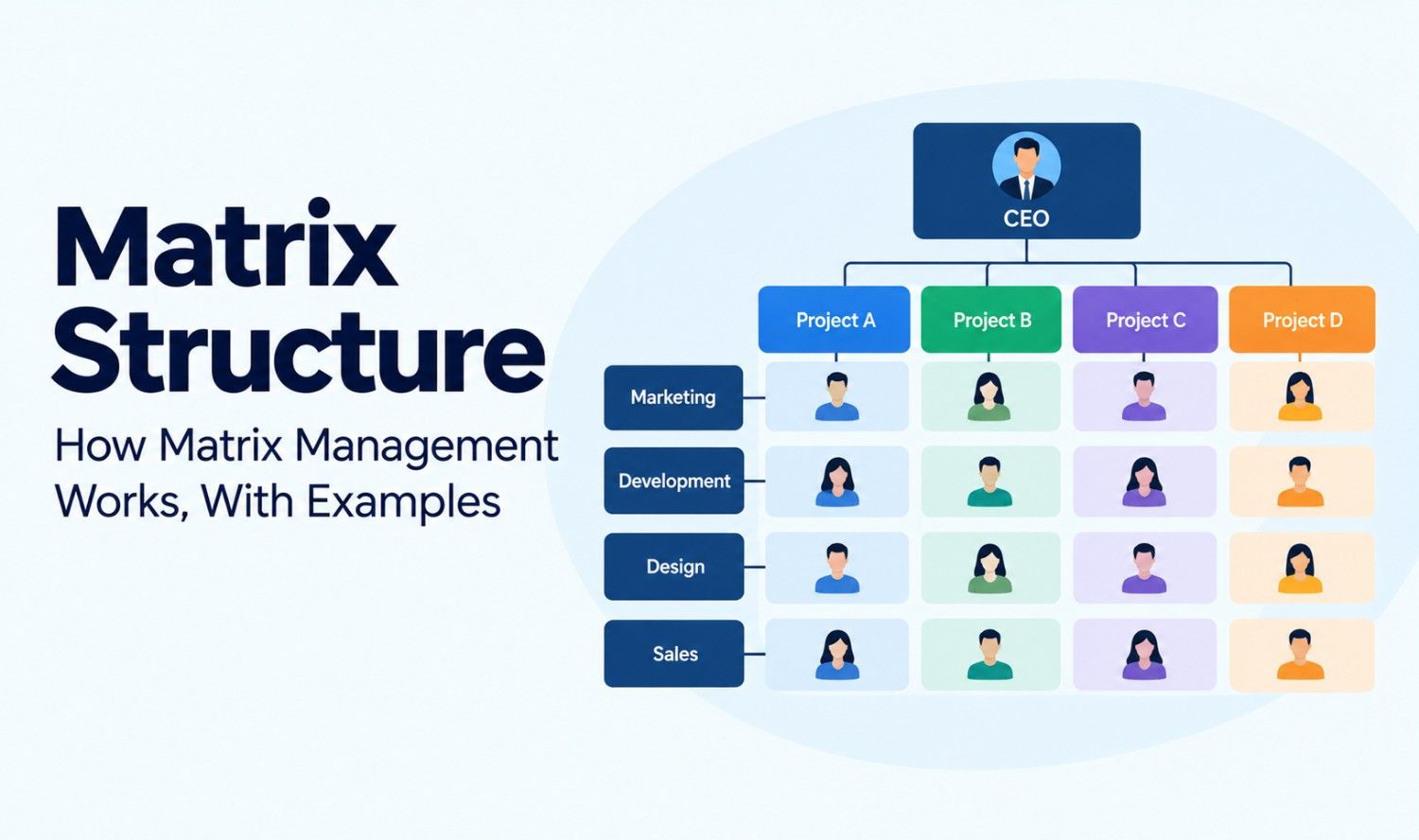
A matrix structure is an organizational design that overlays project or product teams on top of traditional functional departments. Each employee has a home function, like finance or engineering, and also works on one or more cross-functional projects. That creates two lines of reporting, which is why it’s also called a matrix organization or matrixed organization.
Picture a grid. The columns are departments, such as engineering, design and marketing. The rows are projects or products. Each person sits where their department meets their project.
The matrix isn’t new. According to a classic article published by the Project Management Institute (PMI), the formal matrix was “first developed and documented in the United States aerospace industry” during “the growth of the large, complex projects of the 1950s and 1960s.” NASA later published guidance titled “Matrix Management for Aerospace 2000” in 1980.
How Does a Matrix Management Structure Work?
A matrix management structure works by giving each employee two reporting relationships. The functional manager usually handles skills, standards, hiring and career growth. The project or product manager directs day-to-day work, priorities and deadlines for a specific initiative. Both managers share responsibility for the employee’s success.
These two lines are often described as solid and dotted:
| Reporting Line | Who It’s To | What It Usually Covers |
|---|---|---|
| Solid line | The manager with formal authority | Performance reviews, pay, career decisions |
| Dotted line | The secondary manager | Day-to-day tasks, project priorities, coordination |
Which manager holds the solid line depends on the type of matrix. In some companies, it’s the functional manager. In others, it’s the project or product leader.
Here’s what a simple matrix looks like in practice:
| Engineering | Design | Marketing | |
|---|---|---|---|
| Project A | Engineer 1 | Designer 1 | Marketer 1 |
| Project B | Engineer 2 | Designer 2 | Marketer 2 |
| Project C | Engineer 3 | Designer 1 | Marketer 3 |
In this example, Designer 1 works on Projects A and C. They report to the head of design for their craft and to two project managers for their daily work.
Types of Matrix Structure: Weak, Balanced and Strong
There are three main types of matrix structure: weak, balanced and strong. The difference is who holds more power. In a weak matrix, functional managers lead. In a strong matrix, project managers lead. In a balanced matrix, authority is split roughly evenly between the two. Choosing the right type depends on your priorities.
PMI’s article describes each type:
| Type | Who Holds More Authority | PMI’s Description | Best For |
|---|---|---|---|
| Weak matrix | Functional managers | “The balance of power tilts decisively in the direction of line or functional management” | Companies that prioritize deep expertise and standards |
| Balanced matrix | Shared equally | “Various people in the organization have two bosses” | Companies that need both strong functions and strong projects |
| Strong matrix | Project managers | “The balance of power is definitely on the side of project management” | Project-driven companies with tight deadlines |
One useful note: the same PMI source says a true balanced matrix, while “considered by some authorities to be ideal, probably seldom occurs in practice.” Most companies lean one way or the other.
Matrix Structure Examples
Matrix structure examples are common in companies that run many projects or serve many markets at once. Consulting firms, global consumer brands and technology companies often use matrix setups. The examples below are illustrative, showing how the structure typically works rather than describing any specific company’s internal setup.
- Consulting firm: A consultant belongs to a practice, such as finance or technology, and is also assigned to client engagements. They report to a practice leader and an engagement manager.
- Global consumer brand: A marketing manager reports to the global head of marketing and to a regional business leader, such as the head of North America.
- Software company: An engineer belongs to the engineering department and works on a product team. They report to an engineering manager and a product manager.
- Aerospace program: Engineers from different specialties are assigned to a large program while staying in their home departments, the setting where the matrix first developed.
In each case, the matrix lets the company use the same experts across many projects, markets or products.
Advantages of a Matrix Structure
The main advantages of a matrix structure are better use of specialists, stronger cross-functional collaboration and faster information flow. Instead of building a new team for every project, you can share experts across initiatives. People also learn from colleagues in other departments, which helps break down silos and spread knowledge.
Key advantages:
- Efficient use of talent: Specialists can support several projects without changing departments.
- Cross-functional collaboration: Engineers, designers and marketers work side by side.
- Faster information sharing: Communication flows across departments, not just up and down.
- Flexibility: Teams can form and re-form as projects start and end.
- Skill growth: Employees gain broader experience, and project managers build leadership skills.
- Stable home base: People keep their functional team and career path while working on projects.
Disadvantages of a Matrix Structure (and How to Fix Them)
The main disadvantages of a matrix structure are confusing reporting lines, conflicting priorities and slower decisions. Having two managers can pull employees in different directions, especially when those managers don’t agree. Harvard Business Review authors Stanley Davis and Paul Lawrence noted back in 1978 that the matrix has “some significant pathologies.”
Most problems are fixable with clear rules and good communication:
| Problem | What It Looks Like | How to Fix It |
|---|---|---|
| Confusing reporting | Employees aren’t sure who to ask for approval | Define who owns which decisions in writing |
| Conflicting priorities | Two managers ask for different work at the same time | Have managers agree on priorities before assigning work |
| Slow decisions | Too many people need to sign off | Name one final decision maker for each type of call |
| Workload overload | Employees are spread across too many projects | Track capacity and limit project assignments |
| Power struggles | Managers compete for people and resources | Set shared goals and joint performance reviews |
| Unclear accountability | No one owns the outcome | Assign a single owner for every project result |
Matrix vs Other Organizational Structures
A matrix structure sits between a functional structure and a project-based structure. Functional organizations group people by skill, divisional organizations group them by product or region, and projectized organizations build teams around projects. The matrix combines functional and project reporting, giving you some benefits of each, along with extra complexity.
| Structure | How People Are Grouped | Reporting | Best For |
|---|---|---|---|
| Functional | By skill or department | One manager | Stable work and deep expertise |
| Divisional | By product, customer or region | One division leader | Large companies with distinct markets |
| Projectized | By project | One project manager | Companies built around large projects |
| Flat | Few or no management levels | Few managers | Small, fast-moving teams |
| Matrix | By function and project or product | Two managers | Complex work that needs shared experts |
The biggest difference between a matrix vs functional organization is reporting. Functional teams have one boss. Matrix teams have two.
What Does “Matrixed” Mean? Working in a Matrix Environment
When someone says they work in a “matrixed” organization or a matrix environment, they mean they report to more than one manager or work across several teams. It often comes up in job descriptions, such as “experience working in a matrixed environment,” which signals that you’ll need to collaborate and influence without full authority.
Working well in a matrix environment usually takes:
- Clear communication: Keep both managers updated on progress and blockers.
- Prioritization skills: Know how to raise conflicts early instead of guessing.
- Influence without authority: Persuade people you don’t directly manage.
- Relationship building: Build trust across departments, not just within your own.
Bartlett and Ghoshal argued in Harvard Business Review in 1990 that matrix management is “not a structure, a frame of mind.” In other words, the mindset matters as much as the org chart.
When to Use a Matrix Structure
A matrix structure works best when your company runs many projects at once, needs to share scarce specialists and must balance functional expertise with fast delivery. It suits medium and large organizations with complex, cross-functional work. It’s usually unnecessary for small teams or companies with simple, stable operations.
A matrix may be a good fit if:
- You run many projects: Specialists are needed across several initiatives at once.
- Skills are scarce: You can’t afford a dedicated expert for every team.
- Work is cross-functional: Projects need several departments to succeed.
- You operate in many markets: Regional and global priorities must both be managed.
It may not be a good fit if:
- Your team is small: Extra reporting lines add overhead without much benefit.
- Work is routine: Stable, repeatable work rarely needs a matrix.
- Managers can’t align: Without cooperation, a matrix creates more conflict than value.
How to Make a Matrix Structure Work
To make a matrix structure work, define decision rights clearly, align managers on shared goals and give everyone visibility into priorities and workloads. Most matrix problems come from unclear roles and poor communication, not the structure itself. Good processes and the right tools close those gaps before they turn into conflict.
Practical steps:
- Write down decision rights: Clarify who approves budgets, priorities and hiring.
- Align managers regularly: Hold short check-ins between functional and project leaders.
- Share one source of truth: Keep projects, owners and deadlines in a shared system.
- Review workloads: Watch for people stretched across too many projects.
- Use joint performance reviews: Let both managers give input on each employee.
- Train for matrix skills: Help people build influence and prioritization skills.
Automation can also reduce the coordination load. Routine updates, task routing and status reports can flow automatically between teams instead of through manual follow-ups. Our workflow automation services help US businesses connect the tools cross-functional teams already use.
Frequently Asked Questions
What is a matrix structure?
A matrix structure is an organizational design where employees report to two managers: a functional manager and a project, product or regional manager. It combines functional expertise with cross-functional teamwork.
What is a matrixed organization?
A matrixed organization is a company that uses a matrix structure, so employees have more than one reporting line and work across teams. The term is often used in job descriptions to describe collaborative, multi-team environments.
What are the three types of matrix structure?
The three types are weak, balanced and strong. In a weak matrix, functional managers hold more authority. In a strong matrix, project managers do. In a balanced matrix, authority is shared.
What are the advantages of a matrix structure?
Key advantages include efficient use of specialists, stronger cross-functional collaboration, faster information sharing, flexibility and broader skill growth for employees.
What are the disadvantages of a matrix structure?
Common disadvantages include confusing reporting lines, conflicting priorities, slower decisions, workload overload and power struggles between managers. Clear decision rights and aligned goals help reduce these problems.
What is the difference between a matrix and a functional organization?
In a functional organization, employees report to one manager in their department. In a matrix organization, they report to both a functional manager and a project or product manager.
Where did the matrix structure come from?
According to PMI, the formal matrix organization was first developed and documented in the US aerospace industry during the large, complex projects of the 1950s and 1960s.