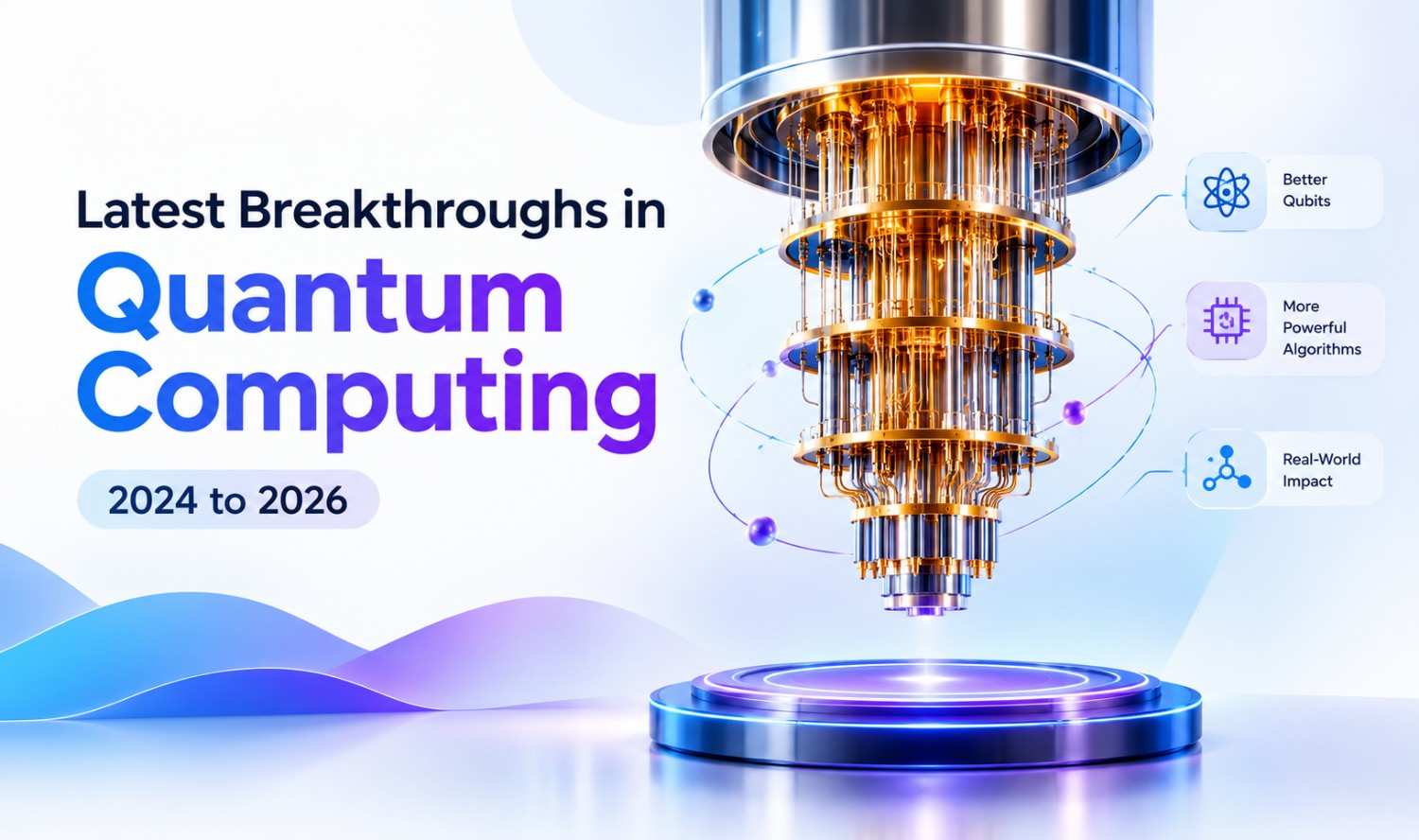

The latest breakthroughs in quantum computing 2024 delivered were about reliability, not size. Between 2024 and 2026, researchers proved that quantum errors can shrink as machines grow, built dozens of error-corrected “logical” qubits, and published the first carefully checked claims of quantum advantage.
What hasn’t changed: quantum computers still can’t do everyday business work or crack modern encryption. Below, we walk through each year’s major results, rate how solid they are, and explain what they mean for US companies.
Quantum Computing Timeline: 2024 to 2026
| When | What Happened | Organization |
|---|---|---|
| April 2024 | Four logical qubits beat their own hardware’s error rate by 800x | Microsoft, Quantinuum |
| August 2024 | First three post-quantum encryption standards published | NIST |
| November 2024 | A 112-hour experiment rerun in 2.2 hours on the Heron processor | IBM |
| December 2024 | Willow chip runs error correction “below threshold” | |
| February 2025 | Majorana 1 topological chip unveiled | Microsoft |
| February 2025 | Ocelot cat-qubit prototype unveiled | AWS |
| September 2025 | Record array of 6,100 atom qubits | Caltech |
| October 2025 | Quantum Echoes algorithm beats a classical method by 13,000x | |
| October 2025 | Nobel Prize in Physics for superconducting circuit research | Clarke, Devoret, Martinis |
| November 2025 | Helios launches with 98 qubits | Quantinuum |
| July 2026 | Verified advantage claim on 70 logical qubits | IBM, University of Chicago |
| September 2026 | Theory for operations over 1,000x faster | Chalmers University |
| October 2026 | Six companies now in DARPA’s final evaluation stage | DARPA |
Quantum Computing Basics You Need First
A qubit is the quantum version of a computer bit, and unlike a normal bit, it can hold a mix of 0 and 1 at once. That property lets quantum computers attack certain problems in new ways. The downside is fragility: the slightest heat or vibration scrambles a qubit and introduces errors.
Four terms come up again and again:
| Term | Plain-English Meaning |
|---|---|
| Physical qubit | A single real piece of quantum hardware, such as one trapped atom |
| Logical qubit | A dependable qubit made by combining many physical qubits so mistakes can be caught and fixed |
| Error correction | The process that turns noisy physical qubits into fewer, trustworthy logical ones |
| Fault tolerance | The stage where a machine fixes errors faster than they pile up, so long programs can finish |
So how big does a useful quantum computer need to be? It depends on the task. Google estimated in May 2025 that cracking 2048-bit RSA encryption would take roughly one million noisy physical qubits running for a week, a 20x drop from its 2019 estimate. Machines with comparable error rates today have about 100 to 1,000 qubits. For scientific simulation, IBM’s 2029 Starling system aims for 200 logical qubits running 100 million operations.
A 4-Point Reality Check for Any Quantum Headline
Before believing a quantum announcement, check four things. Most hype collapses under at least one of them.
- Who reviewed it? A paper in a journal like Nature has passed expert review. A press release or preprint has not.
- What was it compared against? A fair test uses the strongest classical method available, not an easy target.
- Which qubits are being counted? Physical qubit totals sound impressive; logical qubits are what do reliable work.
- Is it a result or a promise? Words like “designed for,” “could” and “up to” signal projections, not measurements.
We use these four checks throughout the rest of this guide.
Latest Breakthroughs in Quantum Computing 2024: Error Correction Finally Works
Until 2024, every qubit added to a machine also added more errors. That year, several teams showed the opposite could happen, which is the foundation every future quantum computer depends on.
Google Willow: Errors Fall as the Chip Grows
Google announced Willow, a 105-qubit superconducting chip, on December 9, 2024. Google built logical qubits from 3×3, 5×5 and 7×7 grids of physical qubits, and the error rate halved at each larger size. Researchers had pursued this “below threshold” milestone for decades.
Willow also completed a benchmark in under five minutes that Google estimates would take the Frontier supercomputer 10 septillion years. Google is clear that this particular benchmark has no known practical use.
Reality check: Peer reviewed in Nature, fairly compared, and a genuine step forward for error correction. The speed headline matters far less than the error result.
Logical Qubits Move From Theory to Hardware
Several groups produced working logical qubits:
- Harvard, MIT and QuEra: A team led by Mikhail Lukin ran error correction on 48 logical qubits built from roughly 300 rubidium atoms. Physics World shared its 2024 Breakthrough of the Year between this team and Google’s Willow work.
- Microsoft and Quantinuum: In April 2024, they made four logical qubits from 30 physical trapped-ion qubits. The logical error rate was 800 times lower than the physical one, across 14,000 error-free runs.
- IBM: Its Heron processor reran a 2023 experiment that had taken 112 hours per data point in just 2.2 hours, about 50x faster, thanks to combined hardware and software gains.
Encryption Standards Arrive
On August 13, 2024, NIST published its first three post-quantum encryption standards. This was not a hardware breakthrough, but it marked the moment quantum computing became a practical security planning issue for every US organization. More on that below.
2025: New Qubit Designs, Bigger Arrays and Faster Results
2025 brought a wave of new hardware approaches, each claiming a better path to reliable machines. Some are proven; others are still bets.
Microsoft Majorana 1
In February 2025, Microsoft revealed Majorana 1, a chip using “topological” qubits that are meant to resist errors by design. Microsoft says it fit eight of these qubits on a chip built to eventually hold one million.
Reality check: The readout results are published in Nature, but error correction has not yet been shown on the chip. The million-qubit figure is a design goal. This is the most contested hardware claim of the period.
AWS Ocelot
On February 27, 2025, AWS introduced Ocelot, a prototype using “cat qubits” that naturally block one common kind of error. AWS estimates the design could cut the cost of error correction by up to 90%.
Reality check: A promising, peer-reviewed design, but a small prototype with five data qubits. The 90% figure is an AWS projection.
Caltech’s 6,100-Atom Array
In September 2025, Caltech researchers held 6,100 cesium atoms in place with 12,000 laser “tweezers,” a record for this type of system. The atoms kept their quantum state for about 13 seconds, with 99.98% accuracy on single-qubit operations.
Reality check: Impressive scale, but the atoms were not yet linked together or error corrected. It shows the size is achievable, not that a full computer works at that size.
Neutral-Atom Machines Head to Customers
Atom-based systems began moving beyond research labs:
- Denmark: Microsoft and Atom Computing are building Magne, with 50 logical qubits from more than 1,200 physical qubits, expected to start its first tasks around the beginning of 2027.
- Japan: National research institute AIST contracted QuEra for a neutral-atom computer installed beside its NVIDIA-powered ABCI-Q supercomputer.
Google Quantum Echoes
In October 2025, Google reported that its Quantum Echoes algorithm ran 13,000 times faster on Willow than the best classical algorithm on a leading supercomputer. Google calls it “verifiable” because another quantum computer of similar quality could reproduce the answer.
Quantinuum Helios
Quantinuum launched Helios on November 5, 2025. It has 98 trapped-ion qubits and produced 48 fully error-corrected logical qubits at a ratio of just two physical qubits per logical qubit. SoftBank and JPMorgan Chase tested it before launch.
A Nobel for the Foundations
The 2025 Nobel Prize in Physics went to John Clarke, Michel Devoret and John Martinis for showing quantum tunneling and energy quantization in an electrical circuit. That work underpins the superconducting qubits used by Google and IBM.
2026: Advantage Claims Meet Pushback
In 2026, the debate shifted from “can quantum computers work?” to “have they actually beaten classical computers yet?” Both sides produced strong evidence.
IBM and University of Chicago: 70 Logical Qubits
On July 30, 2026, IBM and the University of Chicago reported running error-corrected circuits with 70 logical qubits, 2,415 logical two-qubit operations and 468 logical T gates in about 15 minutes. They say top classical simulation methods would need impractically long runtimes, and their method gives a statistical guarantee of accuracy.
Reality check: The strongest advantage claim on error-corrected hardware so far, but it is a preprint awaiting peer review, and the accuracy guarantee is a lower bound rather than a full check.
Classical Computing Strikes Back
A group using D-Wave’s Advantage2 quantum annealer had published in Science that classical computers couldn’t match its simulation of a magnetic material. In 2026, Flatiron Institute researchers reproduced the results using a classical method called tensor networks, with lower error than the quantum machine on some lattice shapes. D-Wave disputes the challenge.
The takeaway: a quantum advantage claim isn’t settled until classical experts have had time to try to beat it.
Faster Operations on Paper
In September 2026, Chalmers University researchers published a Physical Review Letters paper showing how certain quantum operations could finish in one control cycle instead of thousands, over 1,000 times faster for some tasks. Shorter operations leave less time for errors. This is theory for now; an experiment is still to come.
DARPA Narrows the Field
DARPA’s Quantum Benchmarking Initiative asks whether any company can build a quantum computer whose value exceeds its cost by 2033. On October 7, 2026, it moved Atom Computing, Diraq, IBM and IonQ into its final evaluation stage, alongside Microsoft and PsiQuantum.
Superconducting vs Trapped Ion vs Neutral Atom: Which Approach Is Winning?
No single hardware approach has won. Each trades speed, accuracy and scale differently.
| Approach | How It Works | Strengths | Weaknesses | Key Players |
|---|---|---|---|---|
| Superconducting | Tiny circuits cooled near absolute zero | Very fast operations, mature manufacturing | Needs extreme cooling, wiring gets complex at scale | Google, IBM, AWS |
| Trapped ion | Charged atoms held by electric fields | Very high accuracy, every qubit can talk to every other | Slower operations | Quantinuum, IonQ |
| Neutral atom | Uncharged atoms held by lasers | Scales to thousands of qubits, atoms can be moved | Slower operations, still early for error correction at scale | QuEra, Atom Computing |
| Topological | Exotic quantum states in special materials | Could need far less error correction | Not yet proven at scale | Microsoft |
| Photonic | Qubits made of light particles | Works with existing chip factories | Hard to make light particles interact | PsiQuantum |
Company roadmaps show how aggressive the targets are. IonQ, for example, publishes goals of 1,600 logical qubits in 2028 and 80,000 by 2030. Treat these as ambitions until hardware ships.
How Businesses Are Testing Quantum Today
Companies aren’t buying quantum computers to replace servers. They’re renting quantum time through the cloud and pairing it with classical computing.
This hybrid model is where most real activity happens:
- NVIDIA NVQLink, launched October 28, 2025, links quantum processors to GPU supercomputers. It debuted with 17 quantum hardware makers and nine US national laboratories.
- IBM and RIKEN combined an IBM Heron processor with Japan’s Fugaku supercomputer to simulate complex molecules.
Here’s what enterprise testing has produced so far:
| Organization | Partner | What They Reported | How Solid It Is |
|---|---|---|---|
| HSBC | IBM | Up to 34% better prediction of bond trade fills (September 2025) | Best-case figure; not peer reviewed |
| SoftBank, JPMorgan Chase | Quantinuum | Early access testing of Helios (2025) | Evaluation, not production |
| RIKEN | IBM | Molecule simulations using Heron plus Fugaku | Peer-reviewed research |
No business has yet reported quantum computing producing large, repeatable profits in daily operations.
The money flowing in is still enormous. McKinsey’s Quantum Technology Monitor 2026 reports $12.6 billion invested in quantum start-ups in 2025, 6.3 times the 2024 total, and more than $1 billion in quantum computing revenue in 2025. Photonic quantum company PsiQuantum alone raised $1 billion at a $7 billion valuation in September 2025.
What’s Still Standing in the Way
- Scale: Valuable problems may need hundreds to thousands of logical qubits, which could mean hundreds of thousands to millions of physical qubits.
- Cooling and engineering: Superconducting machines run near absolute zero (minus 459.67°F), and each added qubit brings more wiring and more chances for interference.
- Few proven algorithms: Strong evidence of quantum speedups exists for only a handful of problem types, such as simulating molecules and factoring large numbers.
- Hard-to-check answers: Confirming that a quantum computer solved a truly hard problem correctly is a challenge in itself.
- No shared scorecard: Companies pick their own benchmarks. IBM has called for standard benchmarks and open leaderboards, but none are agreed industry-wide.
- Cost and talent: The equipment is expensive and experts are scarce.
Quantum Encryption Risk: A To-Do List for US Businesses
Quantum computers can’t break today’s encryption yet, but your data can still be at risk now. In a “harvest now, decrypt later” attack, criminals steal encrypted files today and wait until a powerful quantum computer can decrypt them. Data that must stay private for many years, such as medical records, legal files and customer information, is most exposed.
The US government has already set the path. NIST published three post-quantum encryption standards in August 2024: FIPS 203 (ML-KEM), FIPS 204 (ML-DSA) and FIPS 205 (SLH-DSA). NIST urged organizations to start adopting them right away. Its draft transition plan would deprecate vulnerable methods such as RSA after 2030 and disallow them after 2035.
Steps to take this year:
- Map every place your business uses encryption: website, VPN, email, databases and vendor connections
- Flag data that needs to stay confidential past 2030
- Ask your cloud and software providers when they will support NIST’s new standards
- Favor vendors already using ML-KEM (Google has switched Chrome and its internal traffic to it)
- Design systems so encryption methods can be swapped without rebuilding everything
Where Quantum Will Be Useful First
The earliest practical wins will likely come from problems that are quantum by nature.
- Chemistry and drug discovery: Molecules behave according to quantum physics, so quantum computers are a natural fit for simulating them. Google’s Quantum Echoes research included an early step toward measuring molecular structure.
- Materials and energy: Better batteries, catalysts and industrial materials are long-term targets.
- Finance and logistics: Banks and shippers are testing optimization and risk models, as HSBC’s trial shows, but no clear edge over the best classical methods has been proven.
- Cybersecurity: Moving to quantum-safe encryption is the one use case with firm government deadlines.
Will Quantum Computing Change AI?
Not soon, and not by replacing GPUs. The realistic future is hybrid: classical AI systems doing the heavy lifting, quantum processors handling narrow calculations they’re suited for, and AI helping to control and correct quantum hardware.
For your business, that means the AI wins available today come from classical systems. If you want measurable results this year, focus on practical AI and machine learning solutions built on current infrastructure, and treat quantum as a long-term watch item.
Quantum Roadmap: 2027 to 2035
| Period | What to Watch |
|---|---|
| 2027 | Magne in Denmark begins early work; more logical qubit records and more classical challenges |
| 2028 to 2029 | IonQ targets 1,600 logical qubits (2028); IBM targets its fault-tolerant Starling system (2029) |
| 2030 | NIST’s draft plan deprecates RSA-style encryption |
| 2033 | DARPA’s deadline to judge whether utility-scale quantum computing is achievable |
| 2035 | NIST’s draft plan disallows quantum-vulnerable encryption |
The single best indicator of real progress: growing numbers of logical qubits with low error rates, confirmed by researchers outside the company making the claim.
Frequently Asked Questions
What is the most recent breakthrough in quantum computing?
As of October 2026, a leading example is IBM and the University of Chicago’s July 2026 report of verified quantum advantage on 70 logical qubits, which is still awaiting peer review. Also in October 2026, DARPA advanced four more companies to the final stage of its quantum evaluation program.
What was the biggest quantum computing breakthrough of 2024?
Google’s Willow chip showing that errors can decrease as a quantum computer grows. Researchers had chased this “below threshold” result for decades, and it is essential for building larger, reliable machines.
What is the difference between a physical and a logical qubit?
A physical qubit is one piece of quantum hardware. A logical qubit combines several physical qubits so errors can be detected and corrected, making it reliable enough for real calculations.
Can quantum computers break encryption today?
No. Google estimates breaking 2048-bit RSA would need around one million noisy qubits running for a week, far more than any current machine. Because stolen data could be decrypted later, NIST recommends adopting post-quantum encryption now.
Which company is leading in quantum computing?
No company leads across the board. Google and IBM are strongest in superconducting qubits, Quantinuum and IonQ in trapped ions, and QuEra and Atom Computing in neutral atoms. DARPA’s final evaluation stage includes Atom Computing, Diraq, IBM, IonQ, Microsoft and PsiQuantum.
Are classical computers still better than quantum computers?
For nearly all practical tasks, yes. In 2026, classical researchers even matched a published quantum annealing result using tensor network methods.
When will quantum computers be useful for business?
Company roadmaps aim for fault-tolerant machines in the late 2020s, with IBM targeting 2029. DARPA plans to determine whether utility-scale quantum computing is feasible by 2033.