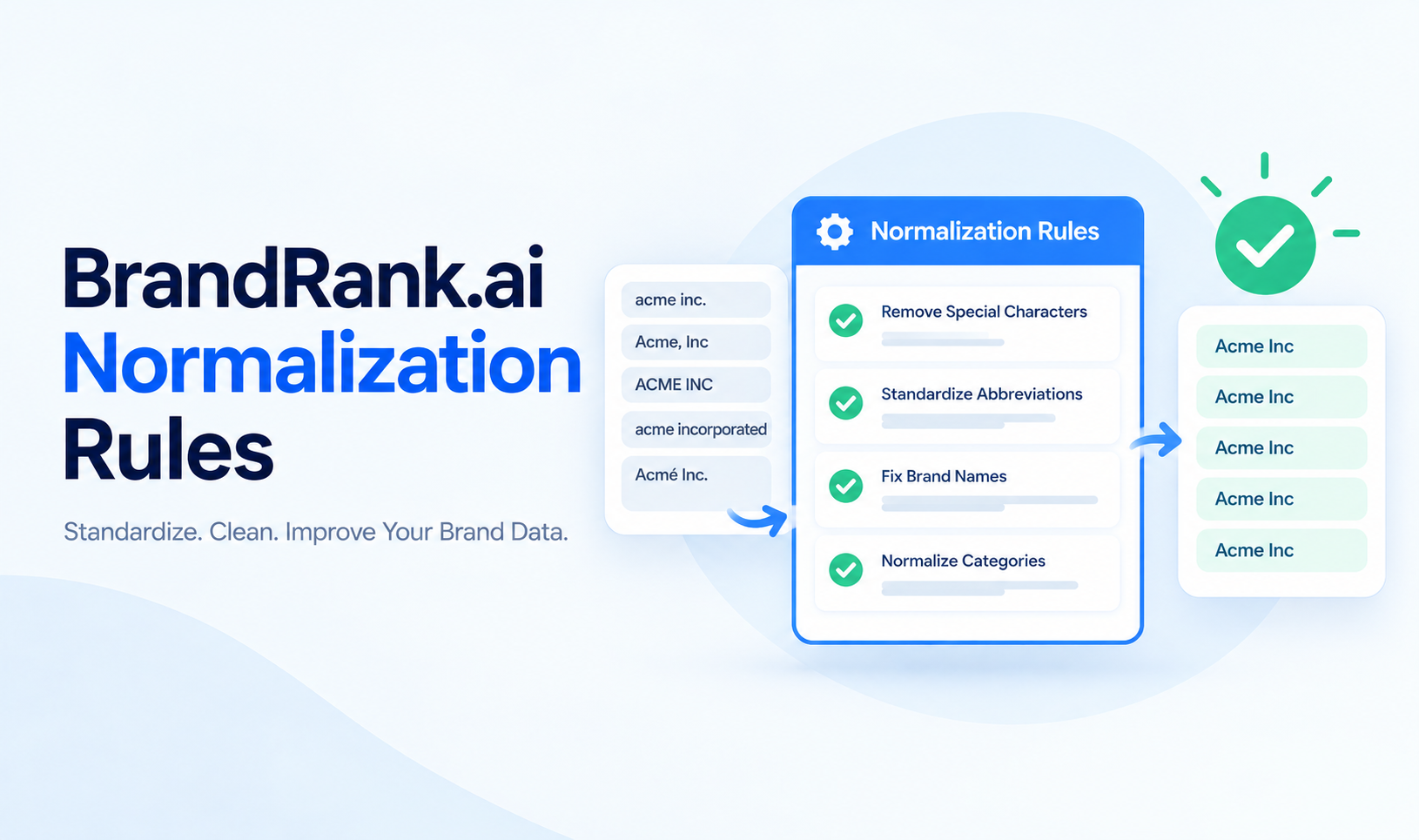

BrandRank.ai normalization rules are the steps used to turn messy brand data, such as name variants, URLs and sources, into one consistent record before measuring how a brand appears in AI answers. Transformation rules then convert those AI answers into metrics like mentions, citations and recommendations.
The phrase is easy to misread. BrandRank.AI is a real platform that tracks brands in AI answer engines, but it hasn’t published a document called “normalization rules.” The term describes the data discipline behind any accurate AI visibility report. This guide gives you 10 practical rules, a before and after example for each, the transformation rules for AI answers and a short Python script you can run today.
What Are BrandRank.ai Normalization Rules?
BrandRank.ai normalization rules are a practical framework for standardizing brand names, URLs, products and sources so that every AI answer about a brand is counted against one correct identity. Without them, “Acme,” “Acme Analytics Inc.” and “acmeanalytics.com” look like three different brands, and visibility numbers come out wrong.
The term grew out of how AI visibility tools work. A platform runs hundreds of prompts through ChatGPT, Gemini, Perplexity and other engines, then collects the answers. Those answers are unstructured text. The same brand can appear under a nickname, an old name, a product name or a regional subsidiary. Normalization is what lets a tool, or your own team, count them correctly.
Think of it in two layers:
- Normalization: Decide the one correct form of each fact about your brand.
- Transformation: Convert raw answers into structured data you can measure and compare.
What BrandRank.AI Actually Measures
BrandRank.AI is an AI search visibility platform that tests how brands appear in answers from seven AI engines and scores their visibility, vulnerability and content readiness. Knowing what it measures explains why clean, normalized brand data matters so much for accurate results.
Here’s what its official site and FAQ confirm:
- Engines tracked: ChatGPT, Gemini, Perplexity, Grok, Claude, Meta AI and DeepSeek.
- Daily testing: A daily search of 170 prompts across those seven engines, according to the BrandRank.AI homepage.
- Recommendation Share™: Its headline metric, which it calls “the number that proves you were actually recommended, not just seen.”
- Three core scores: AI Search Visibility, Brand Vulnerability and Content Readiness, part of its Brand Health and Trust (BHT) framework.
- Brand Risk Monitor: Scores flagged answers across seven damage categories.
- How it works: It captures full responses, identifies cited sources and extracts key claims, according to the BrandRank.AI FAQ.
- Timeline: BrandRank.AI says it sets a baseline within 30 days, with measurable gains typically within 90 days.
The platform is led by co-founder and CEO Pete Blackshaw, and its team brings enterprise brand experience from Nestlé, Nielsen and P&G. Every one of these metrics depends on recognizing the brand correctly in each answer, and that’s the job normalization does.
Normalization vs Transformation: What’s the Difference?
Normalization standardizes data into one consistent form, while transformation changes that clean data into a new structure for analysis. Normalization answers “Is this the same brand?” Transformation answers “What did the AI say about it, and how do we score that?” You need both, in that order.
| Normalization | Transformation | |
|---|---|---|
| Goal | Consistency | Measurement |
| Input | Names, URLs, sources, products | Normalized AI answers |
| Output | One canonical record per entity | Metrics such as mentions, citations, sentiment |
| Example | “Acme Analytics Inc.” becomes “Acme Analytics” | An answer becomes “mentioned: yes, cited: no, recommended: yes” |
| Main risk | Merging things that are different | Misreading tone or intent |
| Runs | First | Second |
A simple way to remember it: normalization cleans the ingredients, and transformation cooks the meal.
10 Brand Name Normalization Rules, With Examples
These 10 rules cover the most common brand data problems in AI visibility work: name variants, legal names, URLs, products, former names, regions, sources and duplicates. Each rule below shows a raw input from an AI answer and the normalized output. The examples use a fictional company, Acme Analytics.
| # | Rule | Raw Input | Normalized Output |
|---|---|---|---|
| 1 | Canonical brand name | “ACME analytics” | Acme Analytics |
| 2 | Alias mapping | “AcmeAnalytics”, “Acme Analytics Inc.” | Acme Analytics |
| 3 | Case, spacing and punctuation cleanup | “Acme Analytics.” | Acme Analytics |
| 4 | URL normalization | http://www.AcmeAnalytics.com/?utm_source=chatgpt | https://acmeanalytics.com |
| 5 | Legal name kept separate | “Acme Analytics, Inc.” | Brand: Acme Analytics; Legal name: Acme Analytics, Inc. |
| 6 | Product and brand separation | “Acme Pulse dashboard” | Brand: Acme Analytics; Product: Acme Pulse |
| 7 | Former names | “DataNest (now Acme Analytics)” | Acme Analytics, alias flagged as former name |
| 8 | Regional entities | “Acme Analytics UK Ltd” | Parent: Acme Analytics; Region: UK |
| 9 | Source normalization | en.m.wikipedia.org/wiki/Acme_Analytics | Source: wikipedia.org |
| 10 | Deduplication | The same answer captured twice in one test run | One record |
A few notes on applying them:
- Canonical name: Pick the exact form you use on your website and in your schema, and use it everywhere.
- Alias list: Keep a living list of every variant you find. It’s the heart of entity resolution, the process of deciding which records refer to the same real-world company.
- Relationships, not erasure: Legal names, products and regional subsidiaries are real and different. Link them to the parent brand instead of overwriting them.
- Exceptions: Flag ambiguous matches for a person to review. “Acme” alone could be a different company entirely.
Transformation Rules That Turn AI Answers Into Metrics
Transformation rules convert each normalized AI answer into structured fields, so you can count mentions, citations and recommendations and compare them over time or against competitors. These fields mirror what AI visibility platforms report, including BrandRank.AI’s focus on whether a brand was recommended, not just seen.
Common transformation rules:
- Mention detection: Was the brand named in the answer? Yes or no.
- Citation detection: Did the answer link to or source content from the brand’s own site or a page about it?
- Recommendation detection: Did the AI actively suggest the brand as an answer to the user’s need?
- Position: Where did the brand appear in a list of options: first, middle or last?
- Sentiment: Was the description positive, neutral or negative?
- Competitor detection: Which other brands appeared in the same answer?
- Claim extraction: What specific facts did the AI state, such as price, features or founding year?
- Risk tagging: Did the answer contain outdated, inaccurate or harmful claims that need correcting?
A mention and a citation aren’t the same thing. Counting every mention as a citation inflates your visibility and hides real gaps in your source content.
How to Run a Normalization and Transformation Task
A normalization and transformation task follows seven steps: keep the raw data, clean it, resolve the entity, normalize it, apply mapping rules, validate the results, then transform the clean data into metrics. Following the same sequence every time keeps your reports consistent and easy to audit.
- Keep the raw data: Save every original AI answer unchanged. You’ll need it to check your rules later.
- Clean basic formatting: Fix case, extra spaces, punctuation and encoding problems.
- Resolve the entity: Decide which records refer to your brand, a product, a subsidiary or a different company.
- Normalize names, URLs and sources: Apply rules 1 through 9 from the table above.
- Apply mapping rules: Link aliases, products, former names and regions to the canonical record.
- Validate: Spot-check a sample against the raw answers, and review every flagged exception by hand.
- Transform and measure: Convert answers into mentions, citations, recommendations, sentiment and risk fields.
For most brands, reviewing the alias list and rules every quarter is a sensible starting point. Review monthly if you’re launching products, rebranding or entering new markets.
A Simple Normalization Script in Python
A short Python script can apply the first four normalization rules automatically: cleaning text, mapping aliases to a canonical name and standardizing URLs. It’s a starting point you can extend with your own alias list. It needs Python 3.9 or later and uses only the standard library.
import re
from urllib.parse import urlparse

# Rules 1 and 2: one canonical name, with an alias list
ALIASES = {
    "acme analytics": "Acme Analytics",
    "acmeanalytics": "Acme Analytics",
    "acme analytics inc": "Acme Analytics",
}

def clean_text(value):
    value = value.strip().lower()
    value = re.sub(r"[^\w\s]", " ", value)    # Rule 3: drop punctuation
    return re.sub(r"\s+", " ", value).strip()  # collapse spaces

def normalize_brand(name):
    return ALIASES.get(clean_text(name), name.strip())

def normalize_url(url):                         # Rule 4
    if "://" not in url:
        url = "https://" + url
    parts = urlparse(url.lower())
    host = parts.netloc.removeprefix("www.")
    path = parts.path.rstrip("/")
    return f"https://{host}{path}"  # drops query strings and tracking tags

raw = [
    ("ACME Analytics, Inc.", "http://www.AcmeAnalytics.com/?utm_source=chatgpt"),
    ("acmeanalytics", "acmeanalytics.com/"),
    ("Acme  Analytics.", "https://acmeanalytics.com/pricing/"),
]

for name, url in raw:
    print(normalize_brand(name), "|", normalize_url(url))
Output:
Acme Analytics | https://acmeanalytics.com
Acme Analytics | https://acmeanalytics.com
Acme Analytics | https://acmeanalytics.com/pricing
Three different inputs now resolve to one brand and one clean domain. Notice what the script doesn’t do: it leaves unknown names unchanged instead of guessing. That’s deliberate, because a wrong merge is harder to fix than a missing one. In production, teams usually run rules like these inside an automated pipeline that pulls AI answers, normalizes them and pushes the results to a dashboard. That’s the kind of workflow automation that saves analysts hours of manual cleanup.
Why Rule Order Changes Your Results
Rule order matters because each rule depends on the output of the one before it, so running them out of sequence can merge the wrong records or miss real matches. If you transform before you normalize, “Acme Analytics Inc.” and “acmeanalytics” get scored as two brands, splitting your mention count.
Common ordering problems:
- Cleaning after matching: “Acme Analytics.” with a period won’t match the alias “acme analytics,” so it’s missed.
- Overwriting raw data: If you normalize the original answers in place, you can’t check later whether a rule was wrong.
- Mapping before resolving entities: A broad alias like “Acme” may pull in a different company before anyone reviews it.
- Measuring before validating: Errors flow straight into reports and decisions.
The safe sequence is always the same: preserve, clean, resolve, normalize, map, validate, transform.
How Normalization Supports AI Search Visibility (and Its Limits)
Normalization gives you an accurate picture of how AI engines describe your brand, and consistent brand data across the web helps those engines identify you correctly. It doesn’t directly raise your rankings or guarantee citations, but it shows exactly where you’re missing and which sources need fixing.
There are two sides to this:
- Inside your reports: Clean data means your visibility, citation and recommendation numbers reflect reality, not duplicates or misses.
- Across the web: When your name, URL, logo and profiles match everywhere, AI engines and search engines have fewer conflicting signals about who you are.
Structured data helps with the second side. Google’s Organization structured data guidelines say some properties help “disambiguate your organization from other organizations.” The key properties are:
- name and alternateName: Your canonical name and its common variants.
- url: Your official website, which Google says “helps Google uniquely identify your organization.”
- logo: The logo you want associated with your brand.
- sameAs: Links to your official profiles. Schema.org defines it as a “URL of a reference Web page that unambiguously indicates the item’s identity.”
Keep expectations realistic. Google states that it “does not guarantee that features that consume structured data will show up in search results.” Normalization and schema improve clarity. Content quality, authority and third-party coverage still decide whether AI engines recommend you.
Common Normalization Mistakes
The most common normalization mistakes are merging entities that should stay separate, deleting raw data and forgetting to update rules as a brand changes. Each one quietly distorts AI visibility reports, and teams often don’t notice until a decision has already been made on bad numbers.
Watch for these:
- Over-merging: Treating a product, subsidiary or similarly named company as the parent brand.
- Under-merging: Missing aliases, so real mentions go uncounted.
- No raw backup: Losing the original answers, so errors can’t be traced.
- Mention equals citation: Inflating visibility by counting every name drop as a sourced citation.
- Stale alias lists: Not adding new product names, former names or regional entities.
- Inconsistent public data: Normalizing your reports while your website, schema and profiles still use different names.
- Full automation with no review: Letting scripts decide ambiguous matches without a human check.
Is This an Official BrandRank.AI Framework?
No. BrandRank.AI hasn’t published a public specification called “normalization rules” or “normalization transformation rules,” and neither term appears on its homepage or FAQ. The phrase is industry shorthand for the data practices that any AI visibility platform, including BrandRank.AI, needs in order to report accurately.
What BrandRank.AI does document publicly is its output: Recommendation Share™, its three core scores and its daily testing across seven AI engines. How it processes data internally isn’t public. Treat any article claiming to reveal BrandRank.AI’s exact internal rules with caution, including lists of plan tiers or scores that don’t appear on its official site.
If you use BrandRank.AI or a similar tool, the rules in this guide still help. They let you prepare clean brand data, check the platform’s results and fix the inconsistencies it uncovers. For teams building their own matching or scoring models, our AI and ML development services can help design them.
Frequently Asked Questions
What are BrandRank.ai normalization rules?
BrandRank.ai normalization rules are practical steps for standardizing brand names, URLs, products and sources into one consistent record before measuring a brand’s visibility in AI answers. They aren’t an official BrandRank.AI specification.
What is a BrandRank.ai normalization and transformation task?
It’s a seven-step process: keep the raw AI answers, clean formatting, resolve the entity, normalize names and URLs, apply mapping rules, validate the results, then transform the clean data into metrics such as mentions, citations and recommendations.
What is the difference between normalization and transformation?
Normalization makes data consistent by mapping every variant to one canonical form. Transformation makes that clean data measurable by converting AI answers into structured fields, such as whether the brand was mentioned, cited or recommended.
Has BrandRank.AI officially published its normalization rules?
No. BrandRank.AI’s public homepage and FAQ don’t mention normalization or transformation. They describe its metrics, including Recommendation Share™, AI Search Visibility, Brand Vulnerability and Content Readiness.
Does normalization improve a brand’s ranking in AI answers?
Not directly. Normalization improves the accuracy of your measurement. Consistent brand data and structured data across the web can help AI engines identify you correctly, but content, authority and third-party coverage still drive recommendations.
Which AI engines does BrandRank.AI track?
BrandRank.AI tracks ChatGPT, Gemini, Perplexity, Grok, Claude, Meta AI and DeepSeek. Its homepage describes a daily search of 170 prompts across these seven engines.
Can a small business apply normalization rules without special tools?
Yes. A spreadsheet with your canonical name, an alias list, your official URLs and a log of AI answers is enough to start. A simple script, like the Python example above, can automate the cleanup as your data grows.