
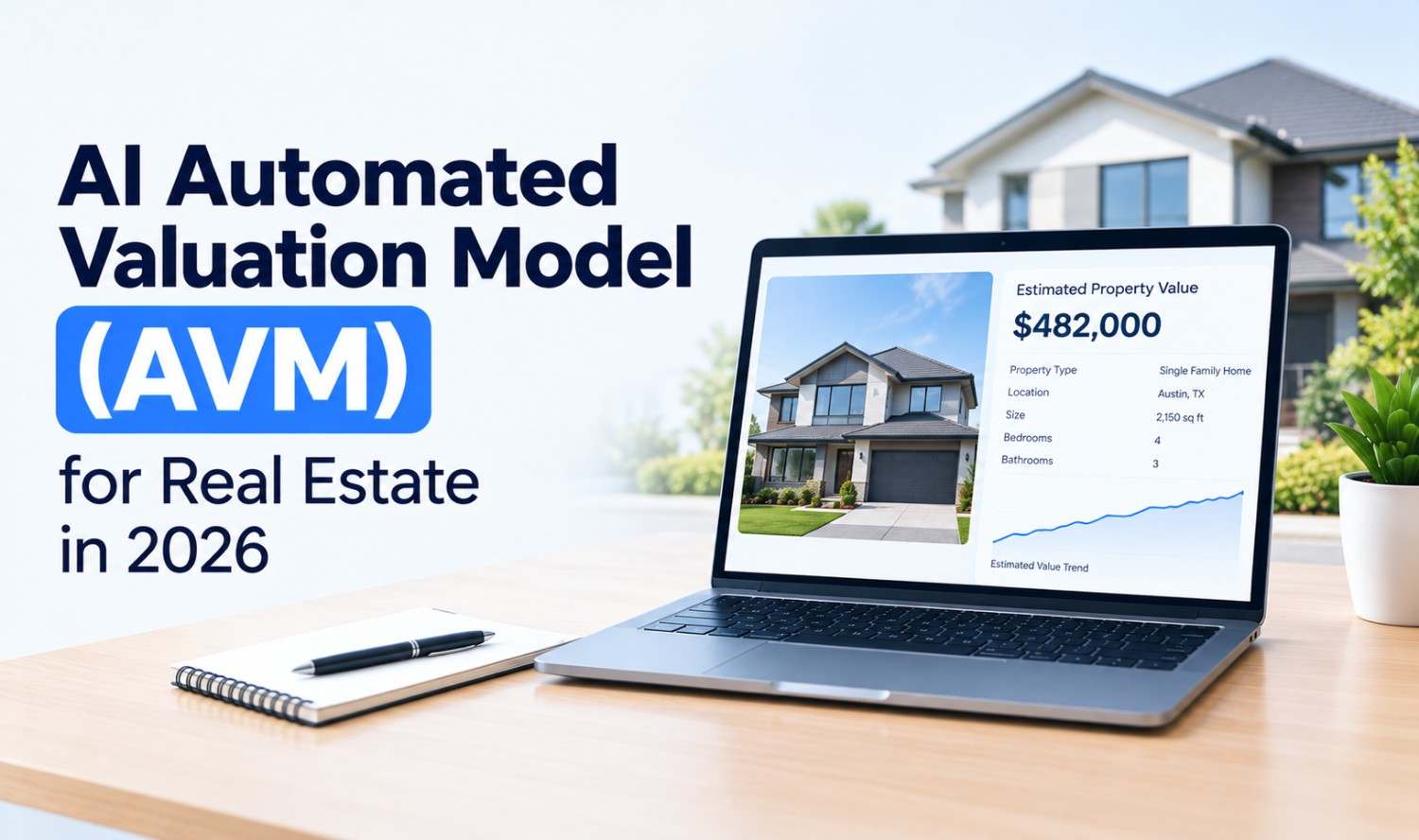

An automated valuation model (AVM) is software that estimates a property’s market value using data and math instead of a home visit. In 2026, an AI automated valuation model (AVM) in real estate goes further, using machine learning to spot pricing patterns across millions of homes and return an estimate in seconds.
Picture this: you open a listing app, and a price estimate appears before the photos finish loading. That number came from an AVM. But how does it work, how far can you trust it, and what changed for lenders in 2026? This guide answers all of that in plain English.
Key Takeaways
- What it is: An AVM estimates property value using data and statistical or AI models.
- How it works: It blends sales comps, property records and market trends.
- Accuracy varies: Estimates are far more accurate for homes on the market than off it.
- New rules: A federal AVM quality control rule took effect on October 1, 2025.
- Not an appraisal: AVMs support decisions but don’t replace a licensed appraiser in every case.
What Is an Automated Valuation Model (AVM)?
An automated valuation model (AVM) is a computer program that estimates what a property is worth. The International Association of Assessing Officers (IAAO) defines it as “a mathematically based computer software program that market analysts use to produce an estimate of market value.” In real estate, AVM is the standard term for these instant estimates.
Under US federal law, the definition is narrower. For mortgage purposes, an AVM is “any computerized model used by mortgage originators and secondary market issuers to determine the collateral worth” of a mortgage secured by a consumer’s main home.
Think of an AVM as a very fast research assistant. It doesn’t walk through the house. Instead, it reads every recent sale, tax record and market signal it can find, then makes an educated estimate.
How Does an AVM Work?
An AVM works by collecting property data, comparing the home with similar recent sales, adjusting for differences, and producing a value estimate along with a confidence score. Most models also factor in local market trends, so the estimate reflects where prices are heading, not just where they’ve been.
The main data inputs include:
- Property records: Square footage, bedrooms, bathrooms, lot size and year built.
- Sales history: Recent sales of nearby homes and past sales of the same home.
- Tax assessments: Public valuation records from local governments.
- Listing data: Active and recently sold listings from MLS feeds.
- Market trends: Price movements by neighborhood, ZIP code or region.
- Images: Some newer models use photos to judge condition and quality.
The output is usually a point estimate, a value range and a confidence score. The confidence score tells you how much the model trusts its own number. Clear Capital, for example, bases its confidence score on forecast standard deviation (FSD), a measure of how widely the estimate could vary.
Types of AVM Models
AVMs use a few main modeling approaches: hedonic pricing, comparable sales and repeat sales, machine learning, and hybrid models that combine them. The IAAO’s AVM standard lists methods ranging from multiple regression and comparable sales adjustment to neural networks and random forests. Each approach has strengths in different markets.
Hedonic Pricing Models
A hedonic model breaks a home into its features and assigns a value to each one. It’s a bit like pricing a car: the engine, mileage and trim each add or subtract from the total. These models usually rely on regression analysis and work well for standard homes in active markets.
Comparable Sales and Repeat Sales Models
Comparable sales models find recently sold homes similar to the subject property, then adjust their prices for differences in size, age or features. Repeat sales models track how the same home’s price changed between past sales. Both stay close to how human appraisers think.
Machine Learning Models
Machine learning models, including neural networks and random forests, learn patterns from huge datasets. They can pick up relationships that simple formulas miss, such as how a nearby park or new transit line affects price over time. This is the heart of most AI AVMs.
Hybrid Models
Hybrid models combine statistical methods with machine learning. A model might use a hedonic baseline, then apply machine learning to adjust for local trends or unusual features. Many modern AVMs work this way to balance accuracy with explainability.
How AI Is Changing AVMs in 2026
AI is changing AVMs in three big ways: deeper historical data, image analysis and better confidence scoring. Newer models rely less on a handful of recent comps and more on long-term patterns, which helps in areas with few sales. Many also use computer vision to read property condition from photos.
Two examples from 2026 show the shift:
- ATTOM: In May 2026, ATTOM launched what it called an “AI-first rebuild” of its AVM. It draws on more than 30 years of time-adjusted transaction history to reduce reliance on recent comparable sales.
- Clear Capital: Its ClearAVM uses image-derived condition and quality ratings from Restb.ai, a factor that many AVMs overlook.
Other trends include faster data refreshes (ClearAVM updates hourly) and wider delivery through APIs and cloud data platforms. The goal is simple: more accurate estimates, delivered where people already work.
AVM vs Appraisal vs Broker Price Opinion
An AVM, an appraisal and a broker price opinion (BPO) all estimate property value, but they differ in who does the work, speed, cost and how they’re used. An AVM is instant and automated. An appraisal is done by a licensed appraiser, often with an inspection. A BPO comes from a real estate agent or broker.
| Factor | AVM | Appraisal | Broker Price Opinion |
|---|---|---|---|
| Who prepares it | Software | Licensed appraiser | Real estate agent or broker |
| Speed | Seconds | Days to weeks | A few days |
| Property visit | No | Usually yes | Sometimes (drive-by or interior) |
| Cost | Low per report | Highest | Moderate |
| Typical use | Screening, refinances, portfolio checks | Purchase mortgages, legal and complex cases | Lender reviews, listing strategy |
| Handles unique homes | Poorly | Well | Fairly well |
Zillow puts it clearly about its own AVM: the Zestimate “is not an appraisal and can’t be used in place of an appraisal.”
How Accurate Are AVMs?
AVM accuracy depends heavily on data. Estimates for homes currently listed for sale are usually much more accurate than for homes off the market, because the model can use the asking price and fresh listing details. Accuracy also drops in rural areas, for unique homes and when markets move quickly.
Redfin shows the gap clearly. As of October 2026, the Redfin Estimate had a median error of 1.91% for homes for sale and 7.50% for off-market homes, according to Redfin’s accuracy page.
Lender-grade AVMs report accuracy in a similar way. ATTOM reports a median absolute percentage error of 2.9% for its 2026 AI AVM in out-of-sample testing, with more than 80% of estimates within 10% of the sale price. These are vendor-reported figures, so check each provider’s methodology before comparing them.
Key accuracy terms to know:
- Median error: Half of estimates are closer than this to the sale price, half are further.
- Within 10%: The share of estimates that land within 10% of the final sale price.
- Confidence score or FSD: The model’s own measure of how reliable an estimate is.
Who Uses AVMs in Real Estate?
AVMs in real estate are used by mortgage lenders, investors, real estate agents, insurers, tax assessors and homeowners. Each group uses them differently, but the common thread is speed. When you need values for one home in seconds or a million homes overnight, an AVM is often the only practical option.
- Lenders: Screening loan applications, home equity lines and refinances.
- Investors and funds: Finding undervalued properties and tracking portfolio value.
- Agents and brokers: Preparing pricing discussions with sellers and buyers.
- Insurers: Checking property values for coverage and risk.
- Tax assessors: Mass appraisal of every property in a county.
- Homeowners: Tracking home value and planning a sale or refinance.
AVM Rules for Lenders in 2026
US lenders that use AVMs for certain mortgage decisions must now follow federal quality control standards. Six agencies, including the CFPB, Federal Reserve, FDIC, OCC, NCUA and FHFA, issued the final rule in 2024. It took effect on October 1, 2025, and applies to mortgage originators and secondary market issuers.
The final rule requires covered institutions to have policies, procedures and controls that:
- Ensure confidence: Provide a high level of confidence in AVM estimates.
- Prevent manipulation: Protect against the manipulation of data.
- Avoid conflicts: Seek to avoid conflicts of interest.
- Test regularly: Require random sample testing and reviews.
- Prevent discrimination: Comply with applicable nondiscrimination laws.
The rule is flexible. It doesn’t prescribe one testing method, so each lender designs controls that fit its size and risk. That makes model documentation, testing records and bias checks more important than ever for anyone building or buying an AVM. This is general information, not legal or lending advice.
A Brief History of AVMs
AVMs are closely tied to mass appraisal, the method tax assessors use to value every property in an area at once. Professional standards and federal rules followed. The IAAO had an AVM standard in place by 2003, and the Dodd-Frank Act of 2010 called for AVM quality control standards for mortgage lending.
Key milestones:
- 2003: IAAO’s Standard on Automated Valuation Models is in place.
- 2010: The Dodd-Frank Act adds AVM quality control requirements to federal law.
- 2018: IAAO revises its AVM standard, adding methods like neural networks and random forests.
- 2024: Six agencies publish the final AVM quality control rule.
- 2025: The rule takes effect on October 1. CoreLogic also rebrands as Cotality.
- 2026: Vendors such as ATTOM release AI-first AVMs.
Popular AVM Providers and Zestimate Alternatives
Popular AVM providers include consumer tools like Zillow’s Zestimate and the Redfin Estimate, plus professional and lender-grade AVMs from companies like ATTOM, Cotality and Clear Capital. If you’re looking for a Zestimate alternative, comparing two or three AVMs side by side often gives a better picture than relying on one.
| Provider | AVM | Main Audience | Verified Detail |
|---|---|---|---|
| Zillow | Zestimate | Consumers | Covers more than 120 million homes |
| Redfin | Redfin Estimate | Consumers | Publishes median error for on- and off-market homes |
| ATTOM | ATTOM AVM | Lenders, investors, data teams | AI-first rebuild launched in May 2026 |
| Clear Capital | ClearAVM | Lenders | Hourly updates, photo-based condition ratings |
| Cotality (formerly CoreLogic) | AVM products | Lenders, insurers | Rebranded from CoreLogic in March 2025 |
This table is for information only, not a ranking or recommendation. Check each provider’s coverage and methodology for your market.
Limitations of AVMs
AVMs struggle when data is thin, properties are unusual or markets change fast. They can’t see a new kitchen that isn’t in public records or a roof that needs replacing unless photos reveal it. Bias in historical data is another risk, which is why the federal rule includes a nondiscrimination requirement.
Main limitations:
- Data gaps: Missing or outdated records lead to wrong estimates.
- Unique homes: Luxury, historic or one-of-a-kind properties have few true comps.
- Thin markets: Rural areas with few sales give models less to learn from.
- Fast-moving markets: Models trained on past sales can lag sudden price shifts.
- Hidden condition: Interior updates or damage may not show up in the data.
- Bias risk: Historical patterns can carry unfair valuation gaps between neighborhoods.
When to use an AVM? It’s a good fit for quick screening, standard homes and large portfolios. When it isn’t: unique properties, low-confidence scores and high-stakes decisions call for a human appraisal.
How to Build a Custom AI AVM
Building a custom AI AVM starts with clean, well-governed data, then moves through model selection, validation and integration. The hardest part usually isn’t the algorithm. It’s getting reliable data, proving the model works across neighborhoods and property types, and documenting everything for compliance.
A typical process:
- Define the use case: Pricing listings, screening loans or tracking a portfolio each need different accuracy and coverage.
- Gather and govern data: Combine sales, property records, listings and market data, with clear rules on access, privacy and updates.
- Engineer features: Turn raw data into useful signals, such as property age, distance to amenities or price trends.
- Train and compare models: Test hedonic, machine learning and hybrid approaches.
- Validate with backtesting: Compare estimates against actual sale prices the model hasn’t seen, across many areas and home types.
- Add confidence scoring: Set thresholds, for example sending low-confidence estimates to a human reviewer. The right threshold depends on your use case.
- Check for bias: Test results across neighborhoods and groups, and document the findings.
- Integrate and monitor: Deliver estimates through an API or dashboard, then recalibrate as the market changes.
Photo-based condition scoring is one area where computer vision development adds real value. For the model itself, BotCircles offers AI and ML development for teams building valuation tools.
Frequently Asked Questions
What does AVM stand for in real estate?
AVM stands for automated valuation model. It’s software that estimates a property’s market value using data, statistics and often machine learning, without an in-person inspection.
Are AVMs accurate?
They can be, especially for homes currently for sale. Redfin reports a median error of 1.91% for on-market homes but 7.50% for off-market homes as of October 2026. Accuracy drops for unique homes and areas with few sales.
Can an AVM replace an appraisal?
Not in every case. AVMs are used for screening and some lending decisions, but complex, high-value or unusual properties usually still need a licensed appraiser. Zillow states that its Zestimate is not an appraisal.
Is the Zestimate an AVM?
Yes. The Zestimate is Zillow’s automated estimate of a home’s market value. It’s a consumer AVM, not an appraisal.
Is there a free AVM?
Yes. Consumer tools like the Zestimate and the Redfin Estimate are free to view. Professional and lender-grade AVMs from providers like ATTOM or Clear Capital are usually paid.
Do lenders use AVMs?
Yes. Lenders use AVMs for screening, refinances and home equity loans. Since October 1, 2025, covered lenders must follow federal quality control standards for AVMs used in certain mortgage decisions.
How is AI used in property valuation?
AI models learn pricing patterns from large datasets, read property condition from photos, and produce confidence scores. Newer AI AVMs also use decades of sales history to value homes in markets with few recent sales.