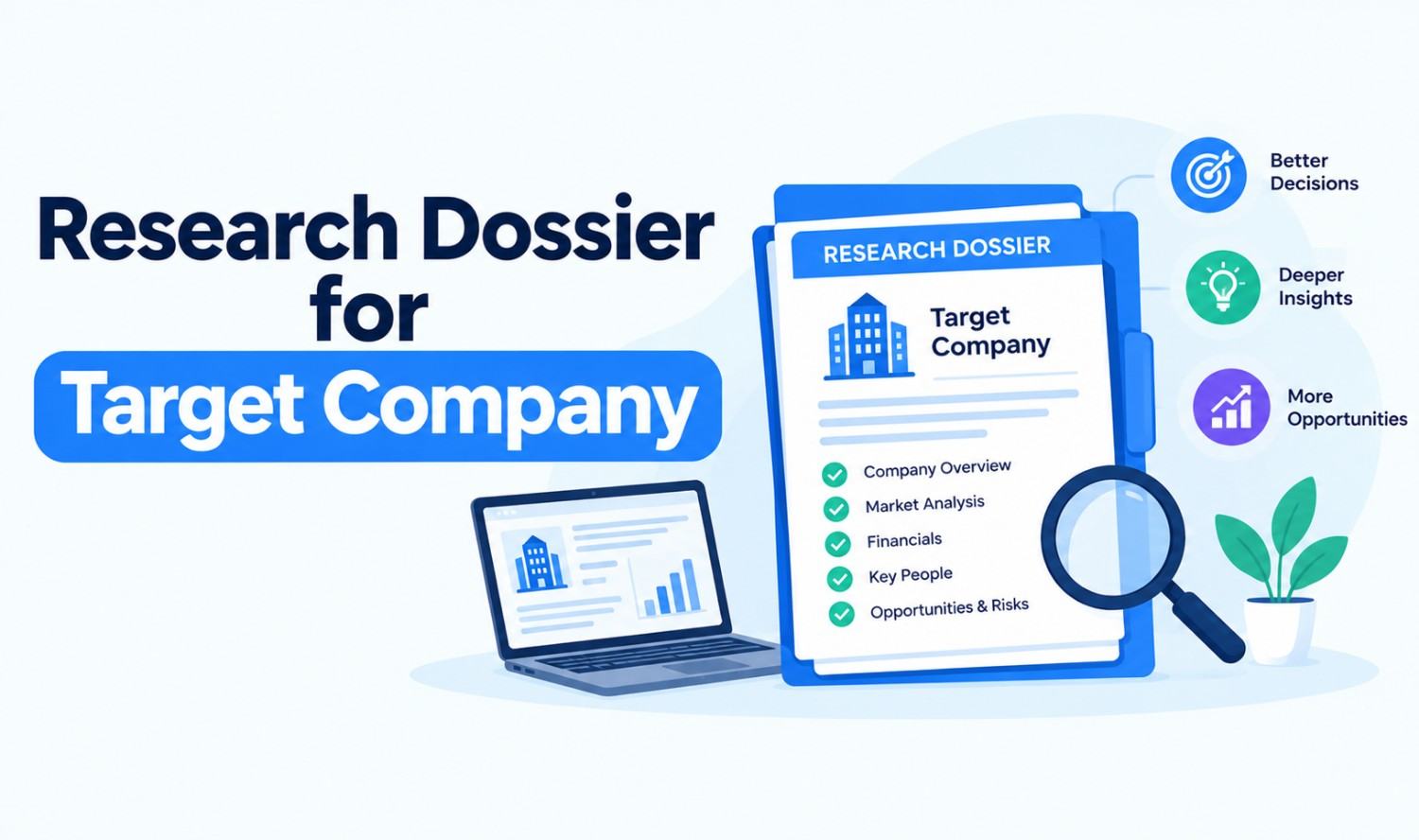

A research dossier for a target company is one organized file that collects what you need to know about a single business before you sell to it, invest in it, partner with it, acquire it or interview there. It covers the company’s profile, people, finances, market, legal record and recent news, with a source for every fact.
This guide covers the 10 sections every dossier needs, the free official US sources to use, a step-by-step process and a template you can copy.
What Is a Research Dossier for a Target Company?
A target company dossier is a structured research document about one specific business. It pulls public records, company materials and news into fixed sections so anyone on your team can understand the company quickly. Unlike a quick Google search, a dossier records where each fact came from and when it was checked.
It’s easy to mix a dossier up with similar documents. Here’s how they differ:
| Document | Purpose | Typical Depth |
|---|---|---|
| Company profile | A quick overview of who the company is | One page |
| Research dossier | Preparing for a specific decision or meeting | Several pages, every fact sourced |
| Due diligence report | Verifying legal and financial details before a deal | Deep, often prepared with advisors |
When You Need a Target Company Dossier
You need a dossier whenever a decision about another company carries real money, time or reputation. Sales teams use them before pitching key accounts, investors and buyers use them before deals, and job seekers use them before interviews. The purpose you have decides which sections matter most and how deep you go.
Common uses:
- Sales and account-based marketing: Learn the buyer’s priorities, decision makers and pain points before outreach.
- Mergers and acquisitions: Screen a target before formal due diligence begins.
- Investing: Check the financial health, leadership and risks of a company you’re backing.
- Partnerships and vendors: Confirm that a supplier or partner is legitimate and stable.
- Job interviews: Understand the company’s products, culture and recent news.
There’s no fixed time a dossier should take. It depends on the purpose and the depth you need.
The 10 Sections of a Research Dossier
A complete research dossier for a target company has 10 sections: overview, offerings, leadership, financials, market, customers, technology, legal and IP, recent news, and risks with next steps. You won’t fill every section equally for every purpose, but keeping the same structure makes dossiers easy to compare and share.
1. Company Overview
Record the legal name, founding year, headquarters, entity type, size and a one-line description. Confirm the legal name and status in the state business registry.
2. Products, Services and Pricing
List what the company sells, who buys it and how it charges. Note the date you saw any pricing, since pricing pages change often.
3. Leadership and Key Decision Makers
Name the executives, board members and the people most relevant to your goal, such as the likely buyer for sales or the founders for M&A.
4. Financial Health
For public companies, pull revenue, profit, debt and cash flow from SEC filings. For private companies, look for funding announcements, hiring trends and any figures the company has published itself, and label estimates clearly.
5. Market and Competitors
Describe the company’s market, its main competitors and how it differs from them.
6. Customers and Positioning
Note major customers, case studies, target industries and the company’s core message.
7. Technology and Operations
Capture the tools and systems the company uses, plus its locations. Job postings often reveal the tech stack and growth areas.
8. Legal, Regulatory and Intellectual Property
Search for lawsuits, bankruptcies, regulatory actions, trademarks and patents. A single court record can change how you approach a company.
9. Recent News and Signals
Track funding rounds, leadership changes, product launches, layoffs, expansions and press coverage from the last 12 months. These signals often give you the best reason to reach out.
10. Risks, Opportunities and Next Steps
Close with your analysis: what could go wrong, where the opportunity is and what you’ll do next. Decision makers often read this section first.
Best Sources for Company Research
The best sources for company research in the US are official government records, followed by the company’s own materials and established news outlets. Start with SEC EDGAR for public company filings, state registries for legal status, USPTO for trademarks and PACER for federal court records, then fill gaps with other sources.
| Source | What You’ll Find | Best For |
|---|---|---|
| SEC EDGAR | Filings from public companies, including registration statements and periodic reports | Financials, risks, leadership |
| State business registries | Legal name, entity type, status and registered agent | Confirming a company is real and active |
| USPTO Trademark Search | Trademark records tied to a company’s brands | Brand and IP research |
| PACER | Federal court records, including lawsuits and bankruptcies | Legal history |
| Company website and press releases | Products, leadership, customers and announcements | Offerings and positioning |
| Established news outlets | Funding, deals, launches and leadership changes | Recent signals |
A few details from the official sites:
- SEC EDGAR: The SEC says EDGAR provides “free public access to millions of informational documents filed by publicly traded companies,” and its full-text search covers more than 20 years of filings.
- State registries: The SBA notes that most states require businesses to register with the Secretary of State’s office or a similar agency, which makes these records a reliable first check.
- PACER: Access costs $0.10 per page, capped at $3.00 for most documents. Fees are waived if your charges are $30 or less in a quarter.
Private companies usually don’t file with the SEC, so their dossiers lean more on state records, the company’s own materials, news coverage and direct conversations.
How to Build a Target Company Dossier Step by Step
To build a target company dossier, define your goal, set the scope, gather official records first, add company and news sources, log the source and date of every fact, then summarize your findings. Following the same order every time keeps your research consistent and makes gaps easy to spot.
- Define the goal: Write one sentence on why you’re researching this company and what decision the dossier supports.
- Set the scope: Choose which of the 10 sections matter most for that goal and how deep each one needs to go.
- Gather official records: Check the state registry, SEC EDGAR, USPTO and PACER before anything else.
- Add company and news sources: Review the website, press releases, job postings and recent coverage.
- Log every source: Next to each fact, note the link and the date you checked it.
- Summarize and analyze: Fill in the risks, opportunities and next steps section, and flag anything you couldn’t confirm.
- Review and update: Ask a colleague to check key facts, then refresh the dossier before each major meeting or decision.
Free Research Dossier Template
This free research dossier template gives you a ready structure for any target company. Copy the header fields and the section table into a document or spreadsheet, then fill each row with facts, sources and dates. Keep the same layout for every company so your dossiers stay easy to compare.
Header fields to include at the top:
- Target company: Legal name and website
- Prepared by: Name and team
- Purpose: The decision or meeting this dossier supports
- Date last checked: When the facts were last verified
- Confidence level: High, medium or low, based on source quality
| Section | Questions to Answer | Main Sources |
|---|---|---|
| 1. Company overview | Legal name, founding year, HQ, size, entity type? | State registry, website |
| 2. Products and pricing | What do they sell, to whom, at what price? | Website, pricing pages |
| 3. Leadership | Who decides, and what’s their background? | Website, SEC filings, news |
| 4. Financial health | Revenue, funding, debt, growth trend? | SEC EDGAR, funding announcements |
| 5. Market and competitors | Who do they compete with, and how do they differ? | News, company materials |
| 6. Customers and positioning | Key customers, industries, core message? | Case studies, website |
| 7. Technology and operations | Tools, systems, locations? | Job postings, website |
| 8. Legal and IP | Lawsuits, bankruptcies, trademarks? | PACER, USPTO |
| 9. Recent news | What changed in the last 12 months? | News outlets, press releases |
| 10. Risks and next steps | What could go wrong, and what’s our next move? | Your analysis |
Using AI to Speed Up Company Research
AI research tools can collect and summarize information about a company in minutes, but they don’t replace verification. They’re best used to draft early sections and surface leads, while a person confirms every important fact against official records before the dossier is used for a decision.
OpenAI, for example, launched deep research on February 2, 2025. OpenAI says it “conducts multi-step research on the internet” and can find, analyze and synthesize hundreds of online sources, with citations. OpenAI also warns that it “can sometimes hallucinate facts” and “may struggle with distinguishing authoritative information from rumors.”
Use AI for first drafts and summaries, ask it to list its sources, then open those sources yourself.
If your team researches companies every week, a custom research agent can pull from your approved sources and fill your template automatically. Our AI agent development services help US businesses build agents like this with human review built in.
Common Mistakes to Avoid
The most common dossier mistakes are relying on unofficial sources, skipping source dates, collecting data without conclusions and missing legal records. These gaps matter. In Bain & Company’s 2020 M&A report, almost 60% of executives attributed deal failure to poor due diligence that did not identify critical issues.
Harvard Business Review’s “The New M&A Playbook” (March 2011), by Clayton Christensen and coauthors, put the M&A failure rate between 70% and 90%. Weak research leads to poor decisions.
Mistakes to watch for:
- Skipping primary sources: Blogs and summaries repeat errors. Go to the official record.
- No dates: A fact without a check date can be months out of date.
- Data without analysis: A dossier should end with conclusions, not just facts.
- Ignoring legal records: A quick PACER search can reveal lawsuits or bankruptcies.
- Trusting AI unchecked: Verify every AI-generated claim before it reaches a decision maker.
Frequently Asked Questions
What is a research dossier for a target company?
It’s a structured document that collects key information about one company, including its overview, leadership, finances, market, legal record and recent news. Every fact includes a source and the date it was checked.
What should a company research dossier include?
Most dossiers include 10 sections: company overview, products and pricing, leadership, financial health, market and competitors, customers, technology, legal and IP, recent news, and risks with next steps.
How do I research a private company?
Start with the state business registry to confirm the legal name and status. Then review the company’s website, press releases, job postings, news coverage and trademark records. Private companies usually don’t file with the SEC.
Where can I find public company filings for free?
SEC EDGAR offers free public access to millions of documents filed by publicly traded companies, including registration statements and periodic reports. Its full-text search covers more than 20 years of filings.
How much does PACER cost?
PACER charges $0.10 per page, capped at $3.00 for most documents. If your charges are $30 or less in a quarter, the fees are waived.
Can AI create a company research dossier?
AI tools can gather and summarize information quickly and draft sections of a dossier. However, tools like OpenAI’s deep research can still get facts wrong, so a person should verify important claims against official sources.
How often should I update a target company dossier?
Update it before every major meeting or decision, and whenever a big signal appears, such as a funding round, leadership change or lawsuit. Record the date of each update.